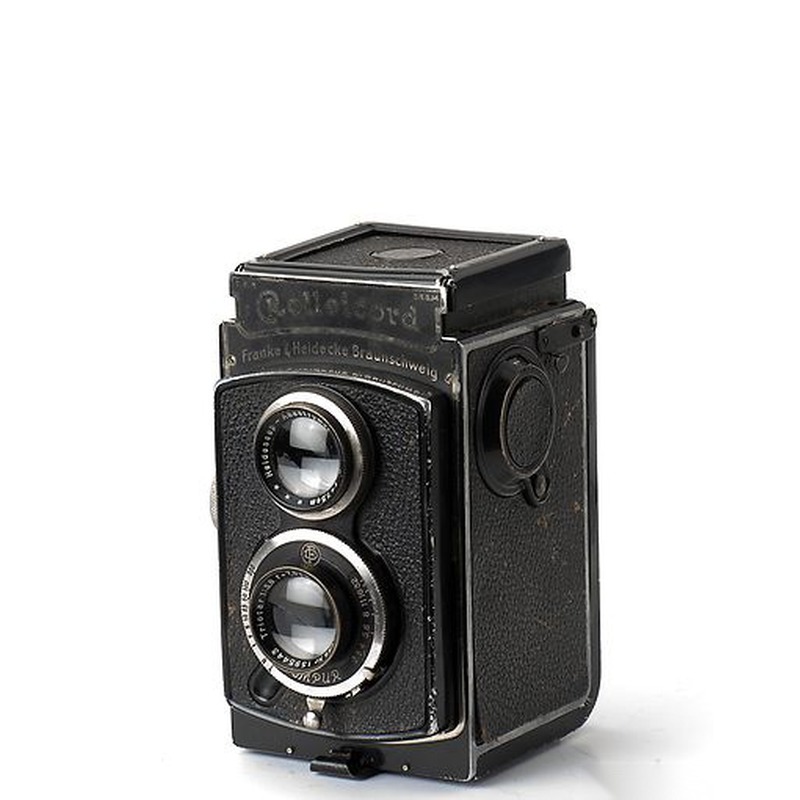
Rolleicord I
Rollei · Germany · 1934–1936 (2 years) · 120 film
The Rolleicord I, introduced in 1934, marks the entry of Rollei into the more accessible medium format market with their first budget-friendly twin-lens reflex camera. Unlike the professional-grade Rolleiflex, the Rolleicord I offered the same basic TLR design principles—waist-level viewing with a ground glass, coupled focusing lenses, and the ability to produce sharp 6×6 cm negatives on 120 film—at a significantly lower price point. This democratization of medium format photography allowed amateur photographers to experience the quality and handling previously reserved for professionals. The camera featured a simple metal construction with a crank for film advance and a built-in sports finders, making it both practical and relatively easy to use for its time.
The Rolleicord series would continue for decades, evolving with improved features while maintaining its position as an excellent value in medium format photography. The Rolleicord I specifically represents the beginning of this important product line, which helped shape Rollei's market position and introduced many photographers to the joys of twin-lens reflex imaging. While not possessing the premium status of its Rolleiflex sibling, the Rolleicord I established a reputation for reliable performance and sensible design that would carry through subsequent models, making it a historically significant camera in bringing medium format quality to a wider audience during the mid-1930s.
Specifications
| Film Format | 120 |
/main.jpg)
/main.jpg)
/main.jpg)
 Enjoy this museum? Support on Ko-fi