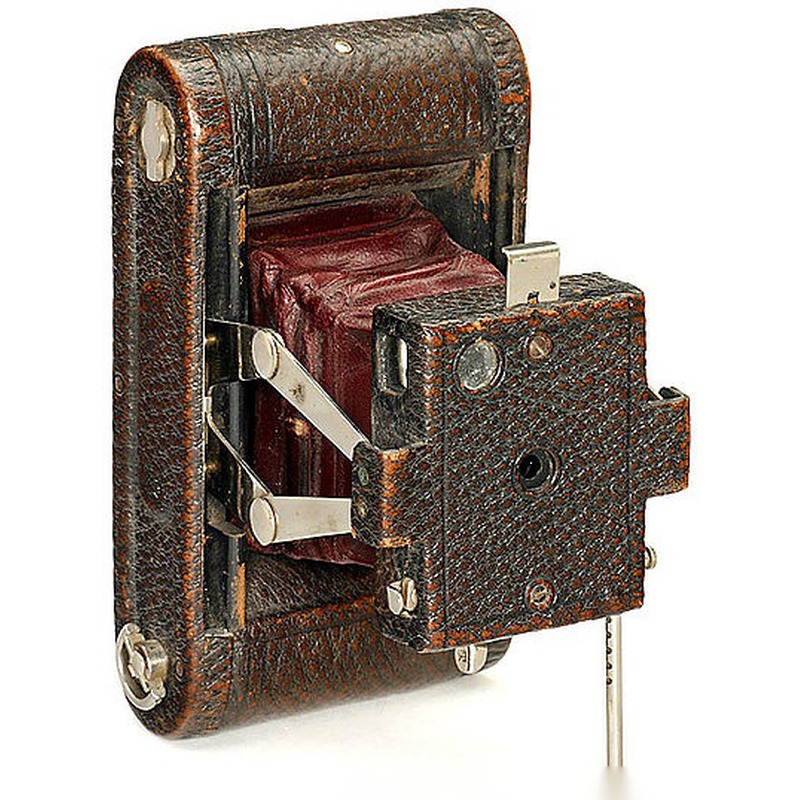
Kodak Folding Pocket No.0
Kodak · USA · 1902–1906 (4 years) · 135 film
The Kodak Folding Pocket No.0 represents an early and significant attempt by Kodak to popularize smaller formats beyond its roll-film dominance. Produced between 1902 and 1906, this compact folding camera utilized 35mm motion picture film (later standardized as 135), packaged in special spools and cassettes developed by Kodak specifically for still photography. Its folding design, typical of Kodak's pocket cameras of the era, allowed the lens board to collapse into a protective case body, making it relatively portable for the time. Key features included a simple meniscus lens, a rotary shutter providing speeds around 1/25th to 1/50th second, and a fixed focus mechanism calibrated for typical snapshot distances. Marketed as a high-quality option for amateur photographers seeking greater convenience and smaller negatives than Kodak's standard roll-film cameras, it capitalized on the emerging availability of 35mm film adapted for still use.
While not achieving the widespread market impact of Kodak's roll-film pocket cameras or the later Leica revolution, the Folding Pocket No.0 was technologically significant as a crucial bridge. It demonstrated the viability and potential of 35mm film for still photography years before the Leica camera (1925) would popularize the format globally. Kodak's experiment with specialized spools and cassettes for this camera was a direct precursor to the standard 135 cartridge. Its production period also coincided with Kodak's intense focus on simplifying photography for the masses, positioning the No.0 as a premium, albeit complex and ultimately niche, pocket-sized alternative. It stands as a testament to Kodak's innovation and its continuous search for formats that balanced quality and portability.
Specifications
| Film Format | 135 |
 Enjoy this museum? Support on Ko-fi