Pricing
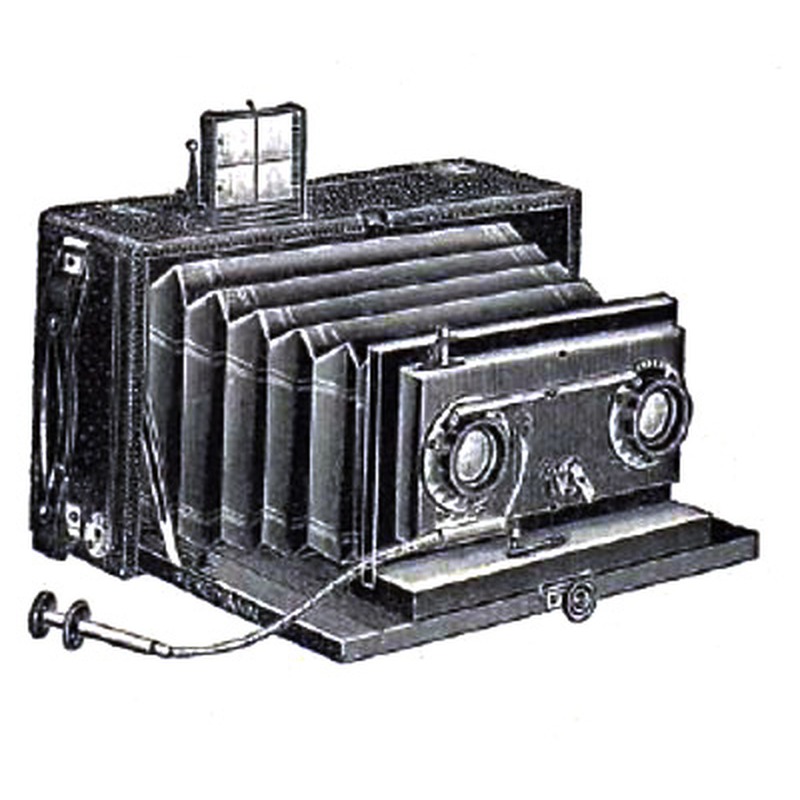
Ernemann HEAG I Stereo
Ernemann · Germany · 1903–1907 (4 years) · 135 film
The HEAG I Stereo was a notable stereo camera produced by the German manufacturer Ernemann between 1903 and 1907, representing an early application of what would become the standard 135 format film. Unlike later stereo cameras that captured two side-by-side images on larger format film, the HEAG I utilized narrower gauge film similar to the 35mm that would eventually dominate photography. The camera featured a twin-lens system designed specifically to create stereoscopic pairs, which could then be viewed with a stereoscope to produce the illusion of three-dimensional depth. Ernemann, known for producing quality photographic equipment before merging into Zeiss-Ikon, constructed this camera with typical German precision, featuring a compact body with bellows focusing and a simple shutter mechanism.
While not as groundbreaking as the Leica I which would later popularize the 35mm format in 1925, the HEAG I Stereo holds interest as an early exploration of smaller format photography for specialized applications. Stereo photography had gained popularity during the late Victorian and Edwardian periods as an entertainment medium, and cameras like the HEAG I catered to this niche market. The camera's relatively narrow production run and specific purpose limit its historical impact, but it represents an important stepping stone in the evolution of compact photography. Its existence suggests that experiments with narrow gauge film for consumer photography occurred well before what is commonly recognized as the dawn of 35mm photography.
Specifications
| Film Format | 135 |
/main.jpg)
/main.jpg)
/main.jpg)
 Enjoy this museum? Support on Ko-fi