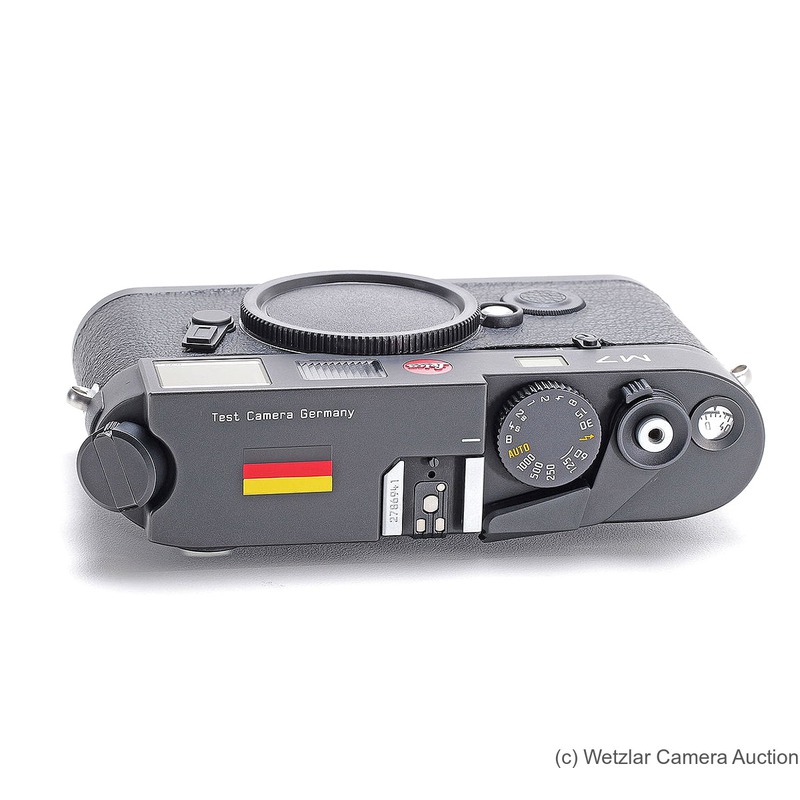
Leica M7 0.72 black 'Test Camera Germany'
Leica · Germany
The Leica M7 represents a significant evolution in Leica's storied rangefinder line, first released around 2002 as the first M camera to offer both aperture-priority automatic exposure and traditional mechanical shutter speeds. This particular model, marked as a "Test Camera Germany," suggests it was likely a prototype, engineering sample, or factory evaluation unit used during Leica's quality assurance process before reaching production. The M7 0.72 designation indicates a viewfinder magnification optimized for lenses between 28mm and 75mm, making it particularly versatile for general photography. As part of Leica's esteemed M series, it features the celebrated M bayonet lens mount, maintaining compatibility with Leica's vast range of M-mount lenses spanning decades, from wide-angle to telephoto optics.
Leica's M7 effectively bridged traditional film photography with modern automation, incorporating electronics for its automatic exposure system while preserving the fundamental rangefinder experience that has made Leica cameras legendary among photographers. The inclusion of an electronic shutter (with speeds from 1,000th to 4 seconds) alongside traditional mechanical speeds (1st to 1/1000th) gave photographers flexibility in various shooting conditions. The compact all-black body, typical of Leica's design philosophy, housed a sophisticated metering system and offered quiet, vibration-free operation. Test models like this one played a crucial role in Leica's manufacturing process, ensuring that each production camera met the company's exacting standards before reaching the market. While this specific unit lacks official documentation confirming its exact purpose or production date, its "Test Camera Germany" marking makes it a potentially interesting artifact in Leica's quality control history.
/main.jpg)
/main.jpg)
/main.jpg)
 Enjoy this museum? Support on Ko-fi