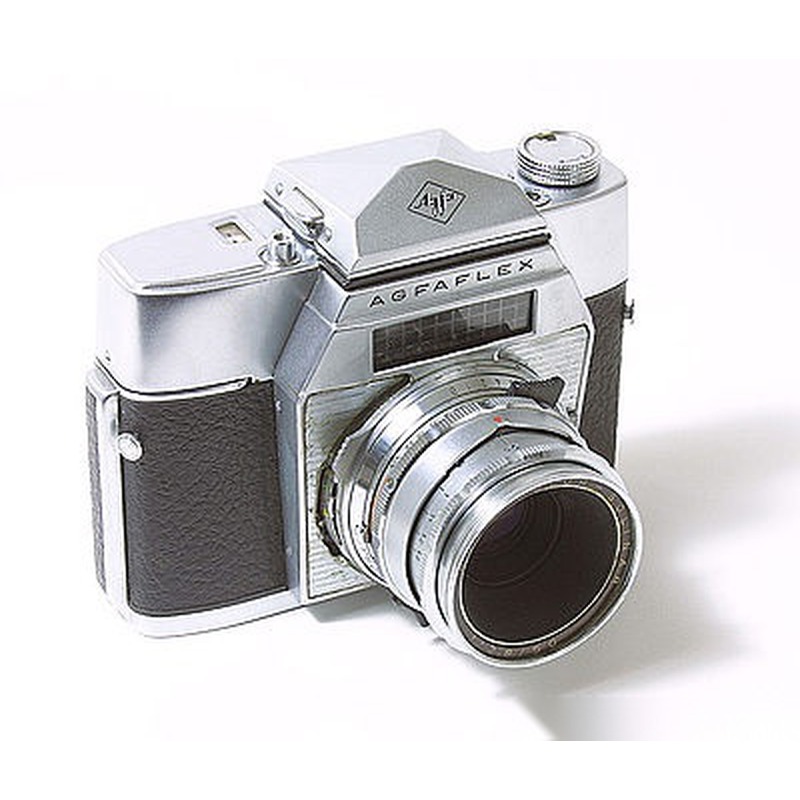
Agfaflex III
Agfa · Germany
The Agfaflex III represents Agfa's continued development of its successful medium format single-lens reflex (SLR) system. As a successor to the Agfaflex I and II, it maintained the core design philosophy of a robust metal body with interchangeable lenses and viewfinders, utilizing Agfa's proprietary Synchro-Compur leaf shutter system. The camera is distinguished by its improved pentaprism finder option, offering a laterally correct and bright image, significantly enhancing the shooting experience compared to the earlier waist-level finders. It typically accepted Agfa's standardized bayonet mount lenses and supported 6x6 cm (2¼" x 2¼") roll film formats. The Agfaflex III was a technically competent workhorse, representing Agfa's efforts to compete in the burgeoning SLR market against established rivals like Hasselblad and Zeiss Ikon Contax, particularly favored by European photographers and enthusiasts who valued its reliability and Agga's lens optics.
While not achieving the legendary status of contemporaries like the Hasselblad 500C or the Nikon F, the Agfaflex III was a significant product for Agga, showcasing their engineering prowess in the medium format SLR domain. It offered a practical and accessible path into quality medium format photography for professionals and serious amateurs alike during the late 1950s and early 1960s. Its reliable leaf shutter system provided consistent flash synchronization speeds, a notable advantage over focal plane shutters, and the system's modularity allowed flexibility for different shooting needs. The Agfaflex III remains a representative example of post-war German photographic manufacturing, embodying a solid, functional approach to medium format SLR design before the tide turned more heavily towards Japanese innovation.
 Enjoy this museum? Support on Ko-fi