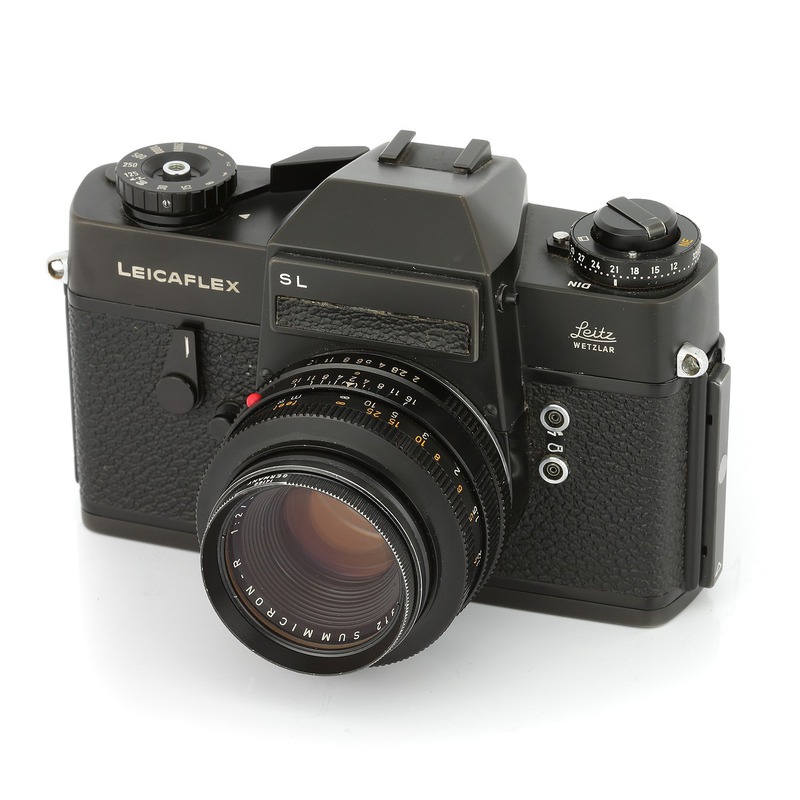
Leicaflex SL black
Leica · Germany
The Leicaflex SL black represents a significant evolution in Leica's single-lens reflex (SLR) camera line, succeeding the original Leicaflex and Leicaflex MOT models. Introduced in 1968, it was a substantial technical upgrade, most notably featuring Leica's first through-the-lens (TTL) exposure metering system integrated into the pentaprism. This innovation allowed for more accurate exposure readings compared to the earlier external CdS meters, placing Leica competitively with Japanese rivals like Nikon and Canon. Maintaining Leica's renowned build quality, the SL was a robust, fully mechanical camera (with optional motordrive) featuring a durable die-cast aluminum body with leatherette covering, precision engineering, and the new Leica R bayonet lens mount. While lacking some modern conveniences like stop-down metering preview, it offered exceptional viewfinder clarity and reliable performance, appealing to professional photographers and serious enthusiasts seeking a high-quality European alternative to dominant Japanese SLRs.
Though not as transformative as the Leica M3 for rangefinders or the Nikon F for SLR mass-market adoption, the Leicaflex SL solidified Leica's serious commitment to the SLR format. It addressed criticisms of earlier models and established a platform that Leica would build upon for decades. Its build quality remains exemplary, and it represents a distinct, well-crafted era in Leica's history before the shift to more electronically controlled models. The "black" finish refers to the standard leatherette-covered body, distinguishing it from the chrome versions.
/main.jpg)
/main.jpg)
/main.jpg)
 Enjoy this museum? Support on Ko-fi