/main.jpg)
Pricing
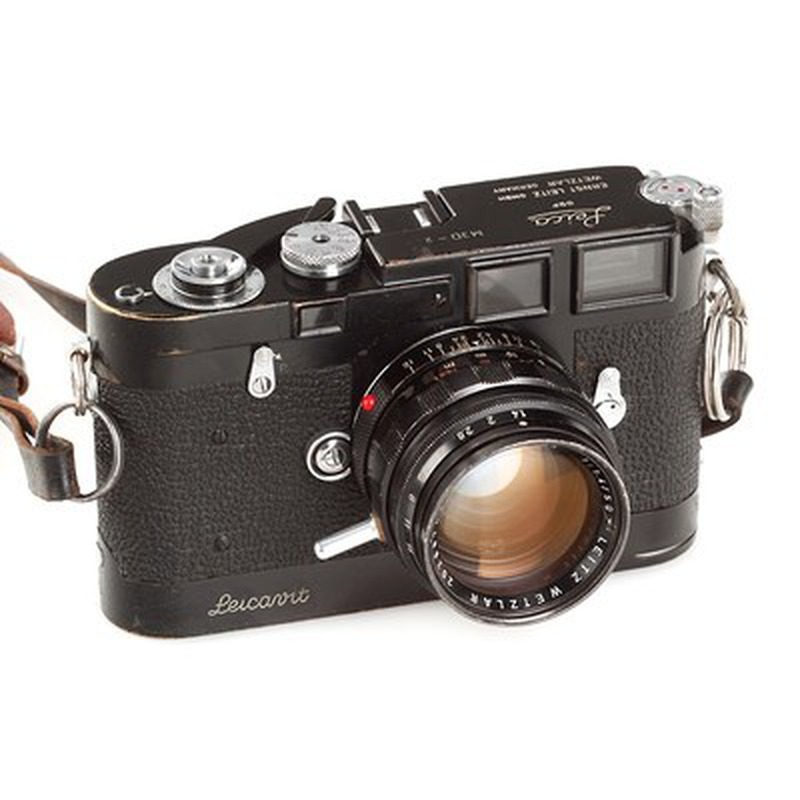
Leica M3 black paint (pre-959401)
Leica · Germany · 1955–1959 (4 years) · 135 film
The Leica M3 black paint, produced from 1955 to 1959 (prior to serial number 959401), stands as a landmark achievement in 35mm camera design, embodying Leica's post-war return to dominance and setting a new standard for precision rangefinder photography. Developed as a successor to the III series, it introduced the revolutionary M bayonet lens mount, designed for rapid lens changes while maintaining exceptional optical alignment, a feature that defined the M system's legacy. Its most significant innovation was the bright, life-size viewfinder with automatic parallax correction and projected framelines for 50mm, 90mm, and 135mm lenses, eliminating the need for external viewfinders and providing an unprecedentedly clear and accurate viewing experience for rangefinder photographers. Coupled with a highly accurate coupled rangefinder based on the classic Leica design but improved for greater ease and precision, the M3 offered an intuitive, fast focusing mechanism crucial for candid and documentary work. Its robust, meticulously crafted black paint finish (distinguished from the later chrome versions) and overall build quality reflected Leica's commitment to precision engineering and durability.
The M3 quickly became the instrument of choice for many of the era's most influential photojournalists and street photographers, including legends like Henri Cartier-Bresson and Ernst Haas. Its combination of brilliant viewfinding, superb handling, and high-quality optics enabled a level of spontaneity and image quality previously unattainable in a portable 35mm camera. While it lacked a built-in light meter (reflecting Leica's purist philosophy), its reliable mechanical operation and the exceptional performance of its M-mount lenses cemented its reputation. The M3 black paint version, being the initial production run in the most desirable finish, represents a particularly significant and scarce artifact of Leica's golden age, capturing the moment when the company definitively redefined 35mm rangefinder photography.
Specifications
| Film Format | 135 |
/main.jpg)
/main.jpg)
/main.jpg)
 Enjoy this museum? Support on Ko-fi