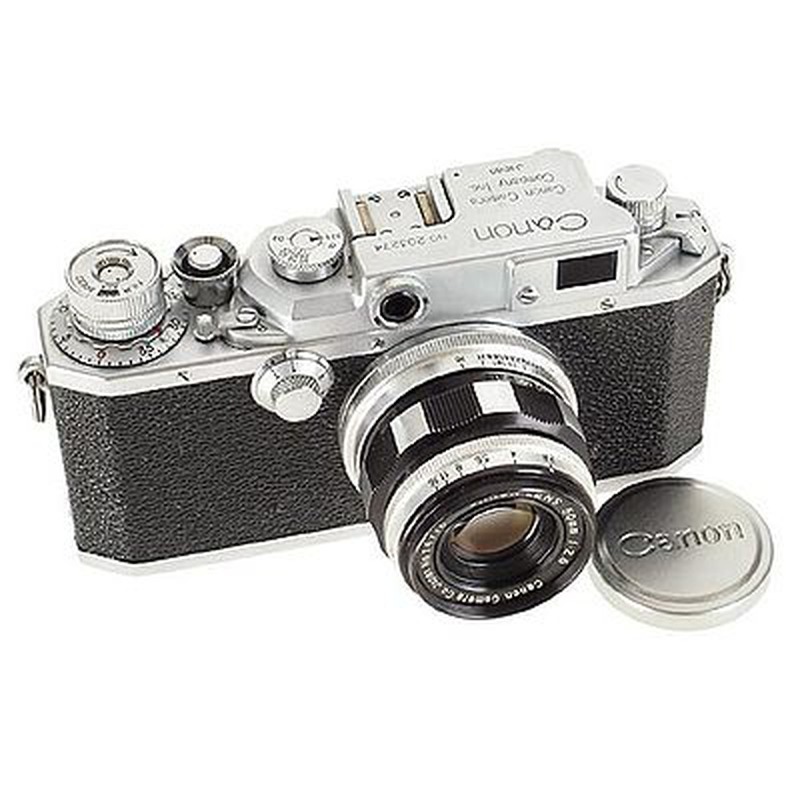
Canon IID2
Canon · Japan
The Canon IID2 is an important camera in Canon's post-World War II development, representing a refined iteration of their successful Canon II series. Building on the foundation of the Canon II (1949), the IID2 improved upon its predecessor with a faster top shutter speed (1/500s vs. 1/400s) and a fully coupled rangefinder, enhancing precision for handheld photography. As a focal-plane shutter rangefinder, it maintained Canon's commitment to quality craftsmanship despite wartime constraints, featuring a die-cast alloy body and robust film transport mechanism. The camera was instrumental in establishing Canon's international reputation, offering advanced features at a competitive price point that appealed to both professionals and serious amateurs during a period when Japanese manufacturers were gaining global market share.
While not revolutionary like the Leica III, the IID2 exemplified Canon's engineering evolution during a pivotal era. Its reliable shutter mechanism and bright viewfinder made it a practical workhorse for documentary and candid photography. Produced from approximately 1950 to 1952, the IID2 helped Canon transition from a domestic player to a formidable competitor, paving the way for future innovations like the Canon IV series. Though overshadowed by later milestones, it remains a historically significant artifact of Japanese camera industrialization and Canon's formative years in the global marketplace.
 Enjoy this museum? Support on Ko-fi