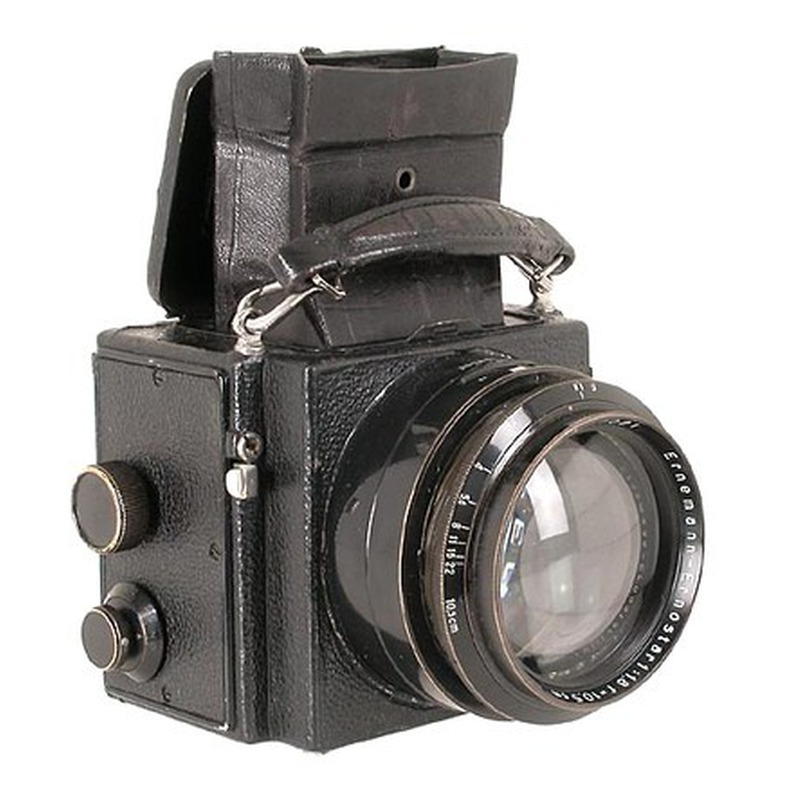
Zeiss Ermanox Reflex
Zeiss · Germany · 1927–1929 (2 years) · 135 film
The Ermanox Reflex represents a pivotal milestone in the evolution of 35mm photography, emerging from Zeiss-Ikon's ambitious efforts to compete with Leica in the late 1920s. Released in 1927, it was the first commercially successful 35mm camera from Zeiss to feature a focal-plane shutter, a significant technical advancement enabling fast shutter speeds and the potential for interchangeable lenses. This design choice, coupled with its relatively compact size compared to earlier large-format equipment, made it a powerful tool for candid photography and photojournalism. It inherited its name and basic concept from the earlier non-reflex Ermanox model but distinguished itself with a reflex viewing system, allowing composition directly through the taking lens. This innovation, combined with its rapid-focal-plane shutter capabilities, positioned it as a serious contender in the emerging small-format market.
The Ermanox Reflex gained considerable fame due to its adoption by pioneering photojournalists, most notably Erich Salomon, who used it to capture unguarded moments of politicians and celebrities with remarkable discretion. Its ability to operate silently and quickly under diverse lighting conditions revolutionized documentary photography. While its production spanned only until 1929, with subsequent models like the Contessa-Nettel and later Contax refining the concept, the Ermanox Reflex cemented Zeiss's credibility in 35mm photography and demonstrated the potential of the focal-plane shutter and reflex viewing for journalistic and candid work. Its legacy lies in being a crucial stepping stone that paved the way for the more refined and influential Contax system that followed.
Specifications
| Film Format | 135 |
/main.jpg)
/main.jpg)
/main.jpg)
/main.jpg)
 Enjoy this museum? Support on Ko-fi