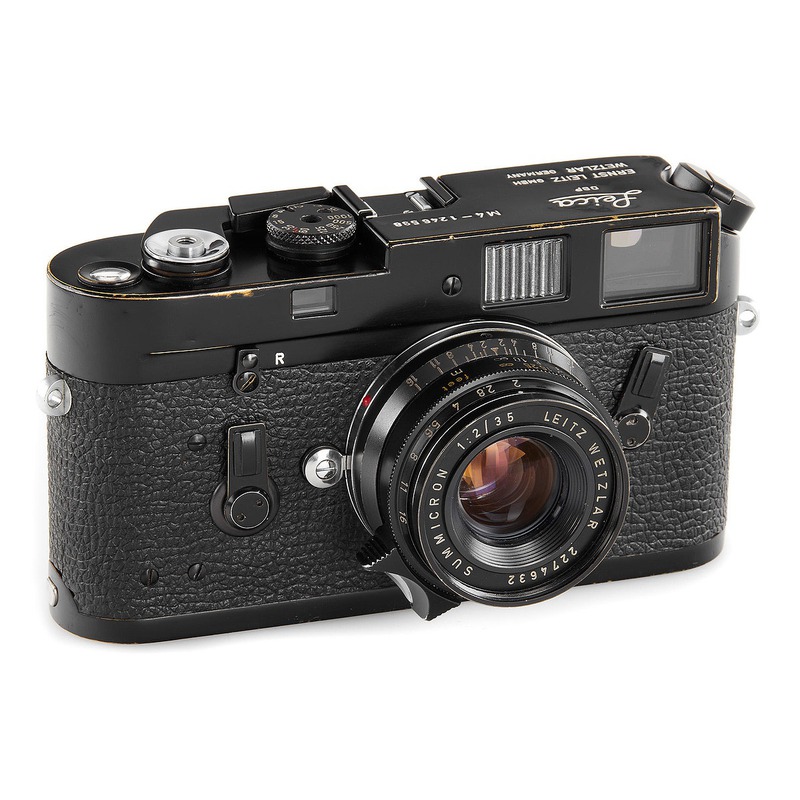
Leica M4 black paint
Leica · Germany
The Leica M4 black paint represents a pinnacle of post-war camera engineering and artisanship. Introduced in 1966, it evolved directly from the revolutionary M3, inheriting its robust rangefinder system and bayonet lens mount while introducing significant advancements. Most notably, the M4 replaced the M3's separate film winding lever and rewind knob with a single, integrated rapid lever-wind mechanism, streamlining operation. It also incorporated a self-resetting frame counter and featured improved framelines covering 35mm, 50mm, 90mm, 135mm, and 28mm lenses, significantly expanding its versatility compared to the M3's initial range. The black paint version was not merely a cosmetic variant; it was a hand-finished, non-standard finish applied by Leica's special orders department, making it exceptionally rare and desirable. This construction utilized the same magnesium alloy body as the standard chrome model but meticulously stripped of chrome plating and painted in black lacquer, resulting in a distinctive, durable finish that has aged beautifully over decades. Renowned street photographers and photojournalists, including Henri Cartier-Bresson and Elliott Erwitt, relied on the M4 for its reliability, quiet operation, and exceptional viewfinder clarity, cementing its reputation as a professional tool par excellence. The M4's design philosophy prioritized mechanical simplicity and precision control, embodying the "Leica M" ethos that has influenced countless rangefinder cameras since.
As the direct successor to the M3 and the last model designed under Leica chief engineer Willi Leitz before his departure, the M4 holds a crucial place in the Leica lineage. It refined the M3's winning formula with user-centric improvements while maintaining the impeccable build quality and tactile feel that defined the rangefinder experience. Its compatibility with the vast range of Leica M-mount lenses spanning decades makes it a remarkably versatile system camera even today. The scarcity and unique aesthetic of the black paint examples have elevated them beyond functional tools to highly coveted collector's items, symbols of Leica's bespoke craftsmanship. While production continued until 1975 with variations like the M4-2 and M4-P eventually taking up the mantle, the original M4, particularly in black paint, remains an icon of rangefinder photography and a benchmark for camera design.
/main.jpg)
/main.jpg)
/main.jpg)
 Enjoy this museum? Support on Ko-fi