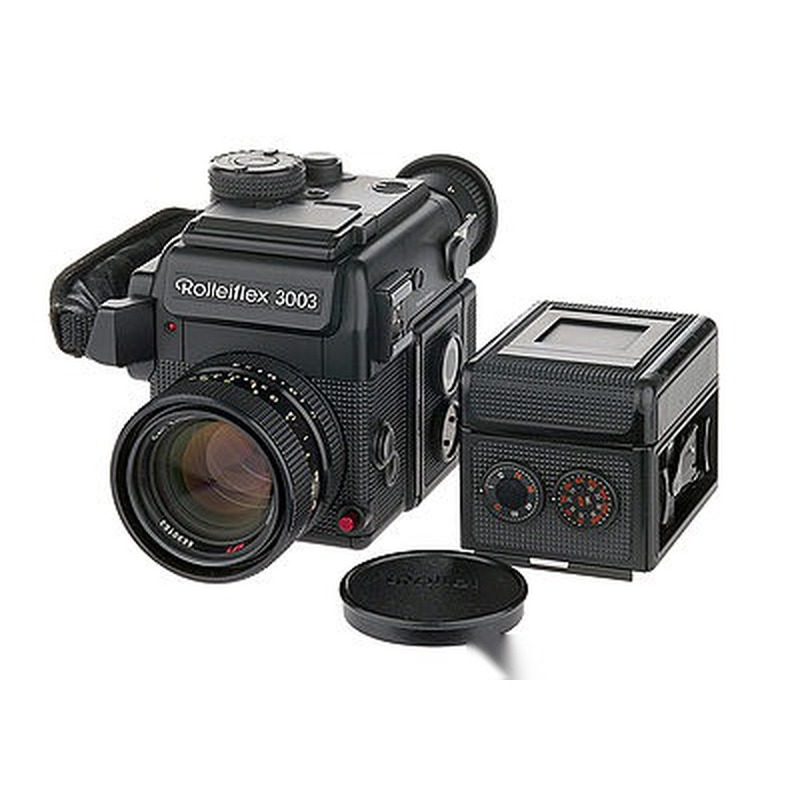
Rolleiflex 3003
Rollei · Germany
The Rolleiflex 3003 was a professional medium format twin-lens reflex (TLR) camera manufactured by Rollei during the 1980s and 1990s. It represented the pinnacle of Rollei's flagship 6000 series, offering advanced features like interchangeable lenses (including a 150mm standard, 80mm wide-angle, and 600mm telephoto), a highly accurate focusing knob with depth-of-field preview, and a robust build using metal components and high-quality materials. While sharing the classic Rolleiflex TLR form factor with its waist-level finder and ground glass focusing screen, the 3003 incorporated modern touches such as improved optics and enhanced handling for professional photographers working with 6x6cm film. It served as a reliable workhorse for studio, portrait, and location photography, representing the refinement of a design lineage dating back to the 1920s, though it lacked the groundbreaking historical impact of Rollei's earliest models.
As the top-tier model in Rollei's 6000 range, the 3003 provided a premium experience with superior mechanics and optics compared to simpler Rolleiflex and Rolleicord models. It appealed to professionals needing a precise, durable medium format system without the bulk of larger format cameras or the complexity of single-lens reflex alternatives. Despite its quality, the 3003 operated in the shadow of Rollei's mid-20th-century heyday and faced competition from other TLRs and emerging medium format SLRs. It remains a capable camera for its era, valued for its ergonomic design and excellent image quality, but it is not considered a transformative or historically iconic instrument in the broader narrative of photography technology.
/main.jpg)
/main.jpg)
 Enjoy this museum? Support on Ko-fi