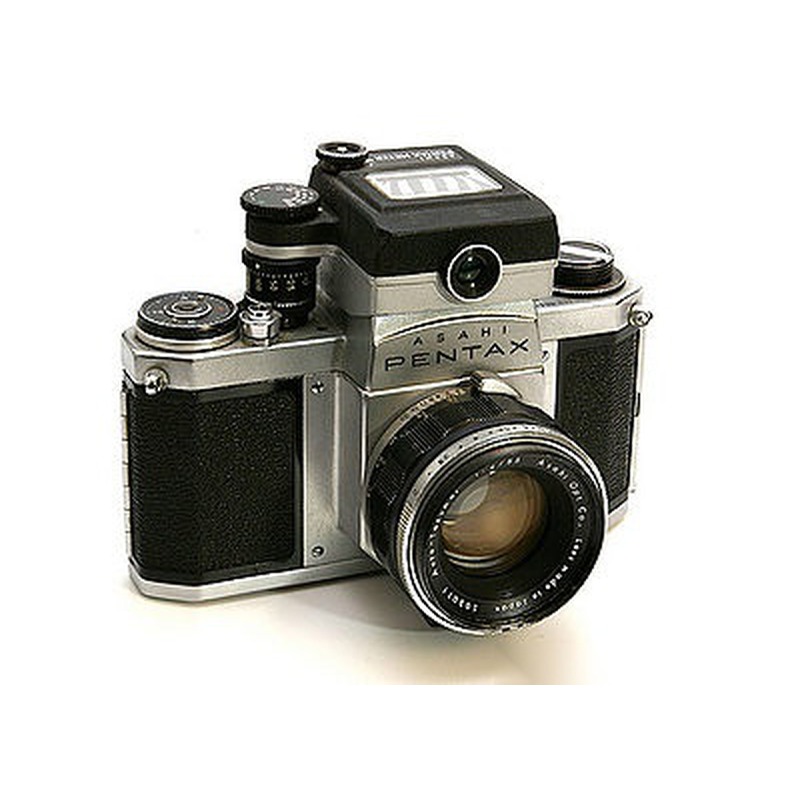
Pentax S2
Pentax · Japan
The Pentax S2 represents a significant step in Asahi Pentax's evolution from their pioneering Asahiflex SLRs towards the iconic Pentax Spotmatic series. Released in the late 1950s, likely as a successor or contemporary to the H1 and H models, it solidified Pentax's reputation for producing reliable, feature-rich 35mm single-lens reflex cameras that were more accessible than European counterparts. While sharing the classic pentaprism viewfinder and M42 screw mount common to early Pentax SLRs, the S2 introduced refinements aimed at improving usability and reliability for photographers transitioning from rangefinders. Its robust construction, featuring a die-cast alloy body with leatherette covering, became a hallmark of Pentax cameras of this era, contributing to their reputation for durability. The camera's significance lies in its role within the lineup that helped popularize the SLR format among serious amateurs and professionals alike, establishing Pentax as a major force in the Japanese camera industry just before the revolutionary Spotmatic's arrival. It embodied practical engineering and solid performance rather than radical innovation, but its contribution to Pentax's market growth was undeniable.
Compared to the later Spotmatic with its revolutionary through-the-lens metering, the S2 operated as a fully manual camera requiring an external selenium cell meter or careful exposure calculation. It offered the core SLR experience: bright viewfinding through the taking lens, excellent handling with its deeply groged focus knob and rapid wind lever, and the flexibility of the vast M42 lens ecosystem. Its straightforward controls and dependable mechanics made it a workhorse camera, valued for its build quality and no-nonsense approach to photography during a period of rapid SLR development.
 Enjoy this museum? Support on Ko-fi