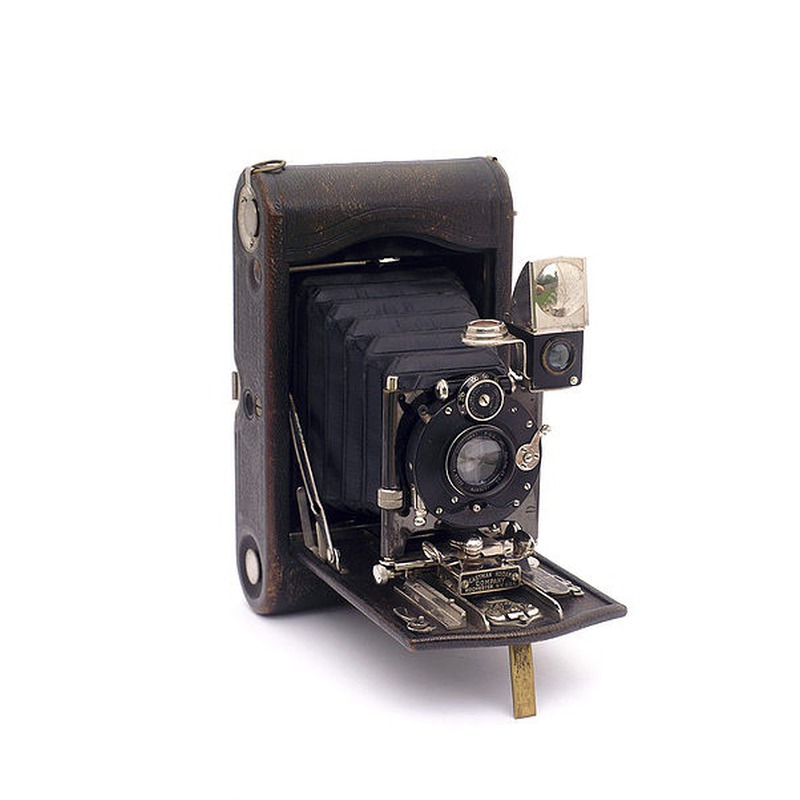
Kodak Autographic No.3
Kodak · USA
The Autographic No.3 represents a significant step in Kodak's strategy to make photography more accessible and personal to amateur photographers. Part of the highly successful Autographic series introduced around 1914, this camera utilized Kodak's innovative Autographic feature. This system involved a small door on the back of the camera (often covered by a leather flap) that allowed the photographer to write information directly onto a thin carbon paper layer covering the film backing using a special stylus. This annotation process, completed before advancing the film, enabled the easy recording of subjects, dates, or notes on the negative itself, revolutionizing how amateurs documented their memories. The No.3 model, typically designed to use Kodak's 3A film (producing 3¼x5½ inch exposures), followed the established pattern of Kodak's folding plate/film cameras of the era. Its construction was generally robust for its time, featuring a leather-covered wooden body and a simple, bellows-based folding mechanism to house the lens board. While lacking the sophisticated mechanics of later professional cameras, its straightforward design and inclusion of the Autographic feature made it a practical and popular tool for dedicated hobbyists seeking greater control and documentation in their photography.
Offering a balance of simplicity and functionality, the Autographic No.3 embodied Kodak's commitment to the amateur market. It provided a clear upgrade from basic box cameras by offering more control over focus and exposure (typically featuring a simple rotary shutter and a meniscus lens with adjustable apertures) while retaining the ease of use central to Kodak's philosophy. The camera's folding design made it relatively portable for its size and format. Its importance lies less in groundbreaking engineering and more in its role as a widely adopted platform for the Autographic system, encouraging a more engaged and documented approach to snapshot photography. It represents a crucial phase in the evolution of amateur photography before the dominance of smaller, more convenient roll-film cameras later in the century.
/main.jpg)
 Enjoy this museum? Support on Ko-fi