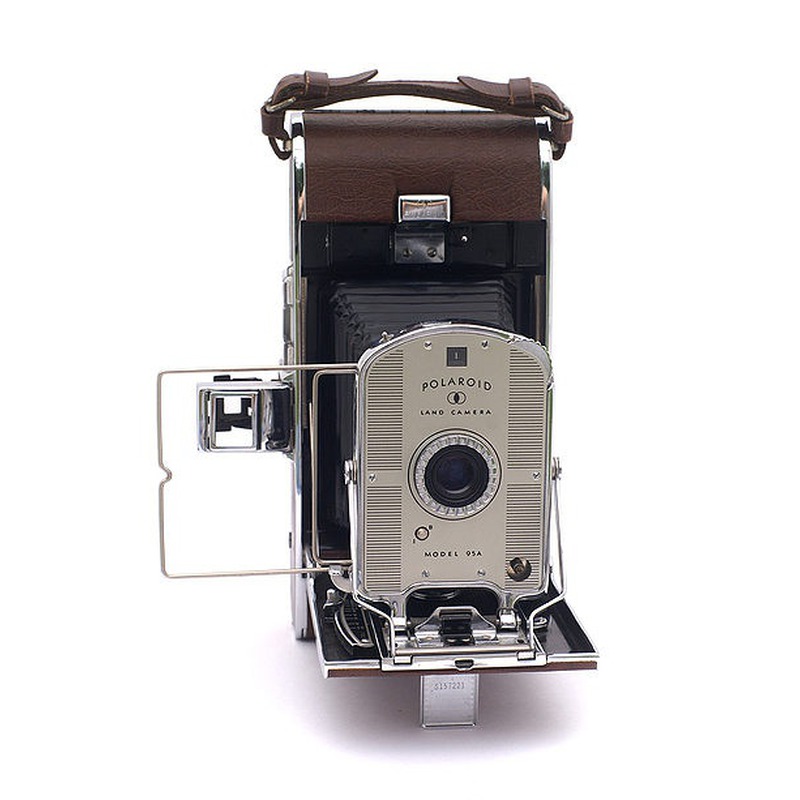
Polaroid 95A
Polaroid · USA
The Polaroid 95A holds a pivotal position as the very first commercially successful instant camera, launched in 1948 by Edwin Land's Polaroid Corporation. Building upon Land's revolutionary instant film technology demonstrated in 1947, the 95A transformed photography by allowing users to produce a finished, sepia-toned print within a minute of exposure without a darkroom. Its design was relatively straightforward for the time, featuring a boxy body constructed primarily of bakelite, a viewfinder on top, and a prominent pull-out bellows system for focusing. The camera used the original Polaroid Land Film Pack type 40, which required peeling apart a negative and positive sheet to develop the image manually. This innovation democratized photography, making instant tangible results accessible to consumers in a way never before possible, directly challenging the dominance of film labs and instigating a new photographic paradigm.
While technically primitive by later standards, the 95A's significance lies purely in its historical moment as the enabler of instant photography. Its introduction effectively created a new market and product category that Polaroid would dominate for decades. The camera's success validated Land's scientific vision and paved the way for the complex, integrated technologies seen in subsequent models like the Swinger and eventually the SX-70. Famous users included artists and photographers who embraced its unique aesthetic and immediacy, though its widespread adoption among the general public cemented its place as a cultural icon of the mid-20th century. The 95A established the fundamental principle of instant gratification in photography that defined Polaroid's identity.
/main.jpg)
/main.jpg)
 Enjoy this museum? Support on Ko-fi