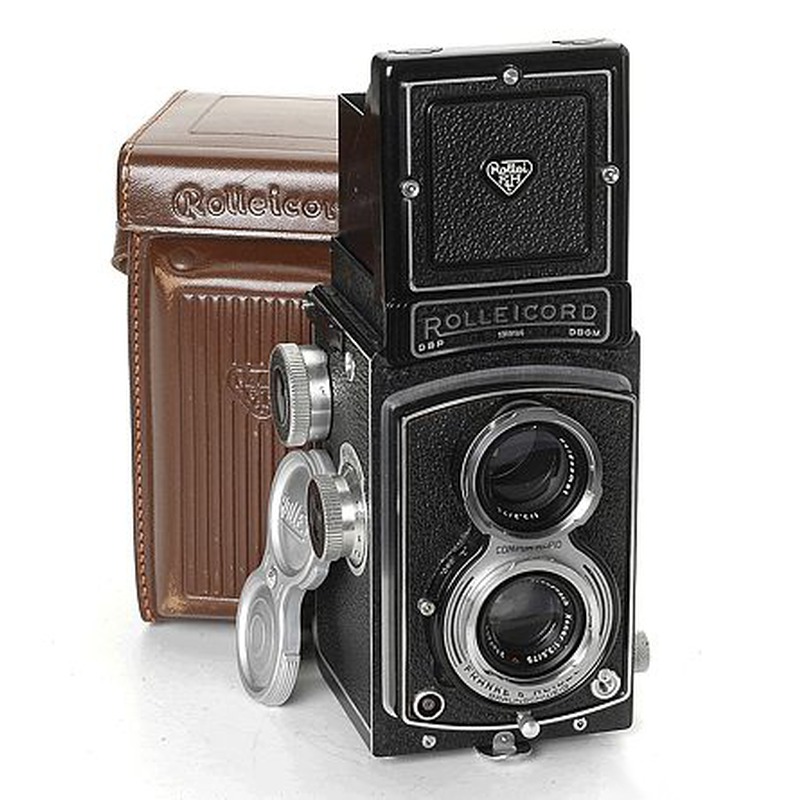
Rolleicord III
Rollei · Germany
The Rolleicord III is a mid-20th-century twin-lens reflex (TLR) camera produced by Rollei, positioned as a more affordable alternative to their premium Rolleiflex models. As a TLR, it features two lenses vertically aligned: a top lens for viewing and focusing on the ground glass screen, and a bottom lens for exposing the 120 film, typically producing 6x6 cm negatives. Rollei introduced the Rolleicord series in the 1930s to broaden the accessibility of medium format photography beyond professionals and serious enthusiasts. The Rolleicord III represents a significant evolution within this line, often incorporating improvements in shutter mechanisms and viewfinders compared to earlier Cord models while maintaining the core TLR functionality and simplified controls characteristic of the budget-conscious Cord series. Its design prioritized reliability and ease of use for amateur photographers seeking the unique waist-level viewing experience and image quality of medium format without the premium cost of a Rolleiflex.
Compared to its famous Rolleiflex sibling, the Rolleicord III generally used slightly simpler materials and lacked some advanced features like self-cocking shutters or parallax correction masks, but it retained the robustness of Rollei's engineering for its class. It played a crucial historical role by introducing countless photographers to the world of medium format roll film, fostering skills that often led to future Rolleiflex use or deeper involvement in photography. Its production spanned several years during the 1950s and early 1960s, making it a common sight in amateur hands during that era. The camera is valued today for its straightforward mechanical operation, the distinctive square format it produces, and its connection to Rollei's legacy of accessible quality imaging.
/main.jpg)
/main.jpg)
 Enjoy this museum? Support on Ko-fi