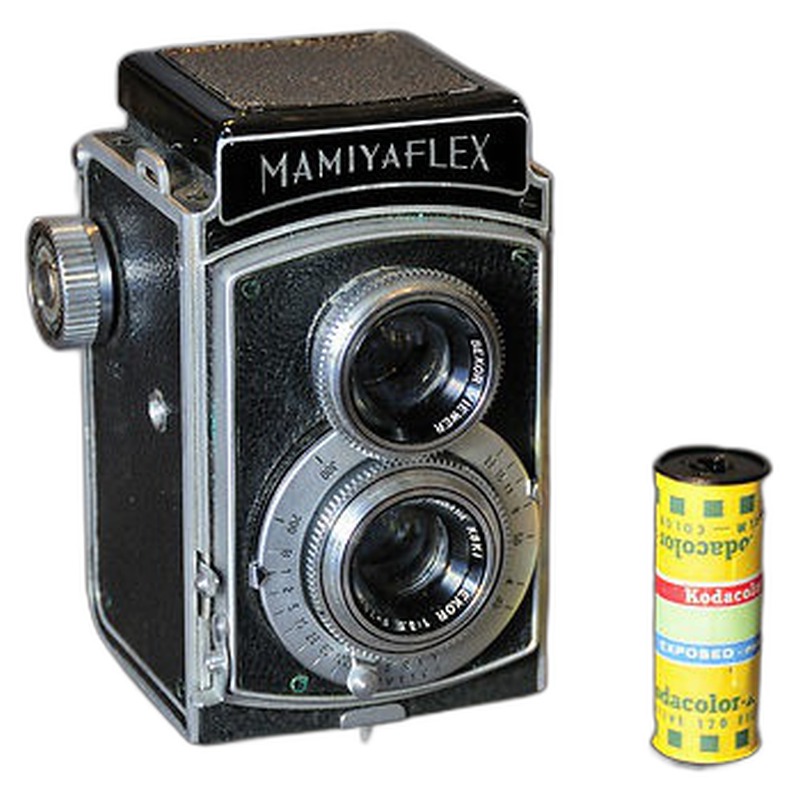
Mamiyaflex I
Mamiya · Japan
The Mamiyaflex I represents Mamiya's initial foray into the twin-lens reflex (TLR) format, a significant category in mid-century photography. As one of the earliest models in this line, it established the foundation for Mamiya's subsequent and highly successful range of medium format TLRs. Its design reflected the robust, practical approach characteristic of Japanese camera manufacturing at the time, featuring coupled range finders and a ground glass focusing screen adapted for the 6x6 cm format. While not incorporating the advanced features or widespread acclaim of later Mamiyaflex models or European competitors like Rolleiflex, the Mamiyaflex I provided an accessible entry point into high-quality medium format photography for professionals and serious amateurs in the post-war era. Its construction prioritized functionality and durability within its price point, contributing to Mamiya's reputation for reliable photographic equipment.
Part of a lineage that would eventually include iconic models like the C series, the Mamiyaflex I holds a specific place in the history of Japanese camera innovation. It demonstrated the company's ability to compete effectively in the professional medium format market against established European brands. The camera's existence underscores Mamiya's strategic expansion beyond earlier press and view camera models, leveraging the TLR's advantages for portability and waist-level composition. Though details like its exact production period or specific innovations are less documented than later iterations, the Mamiyaflex I remains an important artifact illustrating the origins of Mamiya's dominance in the medium format sector.
/main.jpg)
/main.jpg)
/main.jpg)
 Enjoy this museum? Support on Ko-fi