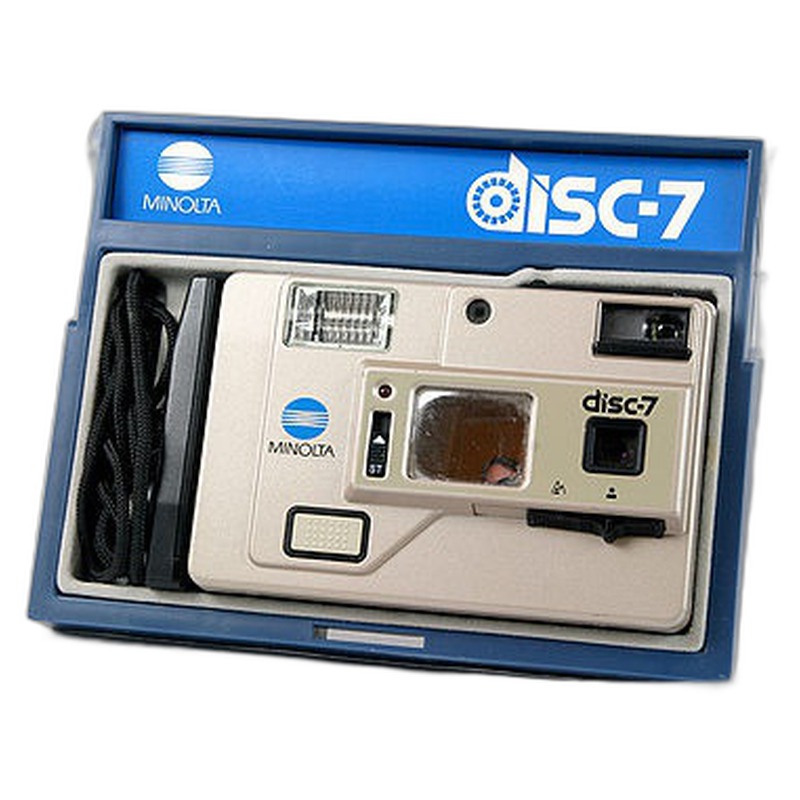
Minolta Disc 7
Minolta · Japan
The Minolta Disc 7 represents Minolta's participation in the short-lived disc film format popular in the mid-1980s. Utilizing Kodak's circular film cartridges, it aimed to provide a compact and convenient snapshot camera. Its defining characteristic was the disc itself, holding 15 small exposures in a flat, easy-to-load package, catering to the consumer desire for pocketable photography with minimal fuss. The camera featured a fixed-focus lens and basic automatic exposure, designed purely for point-and-shoot simplicity, emphasizing ease of use over technical sophistication or image quality. It was part of a wave of disc cameras produced by major manufacturers before the format's decline due to inherent limitations in image resolution and high film costs.
Following the discontinuation of disc film, these cameras became relics of a specific technological experiment in consumer photography. The Minolta Disc 7 serves as a practical example of the format's characteristics: its signature flat profile and the unique circular negatives it produced. While functional for its time, the image quality was notably inferior to 35mm film, contributing to the format's eventual obsolescence. It holds interest primarily as a curiosity representing a brief chapter in photographic history, focused solely on maximizing portability and ease of use at the expense of performance and longevity.
/main.jpg)
/main.jpg)
 Enjoy this museum? Support on Ko-fi