/main.jpg)
Pricing
Leica MP black (2003, w/Leicavit)
Leica · Germany · 2003 · 135 film
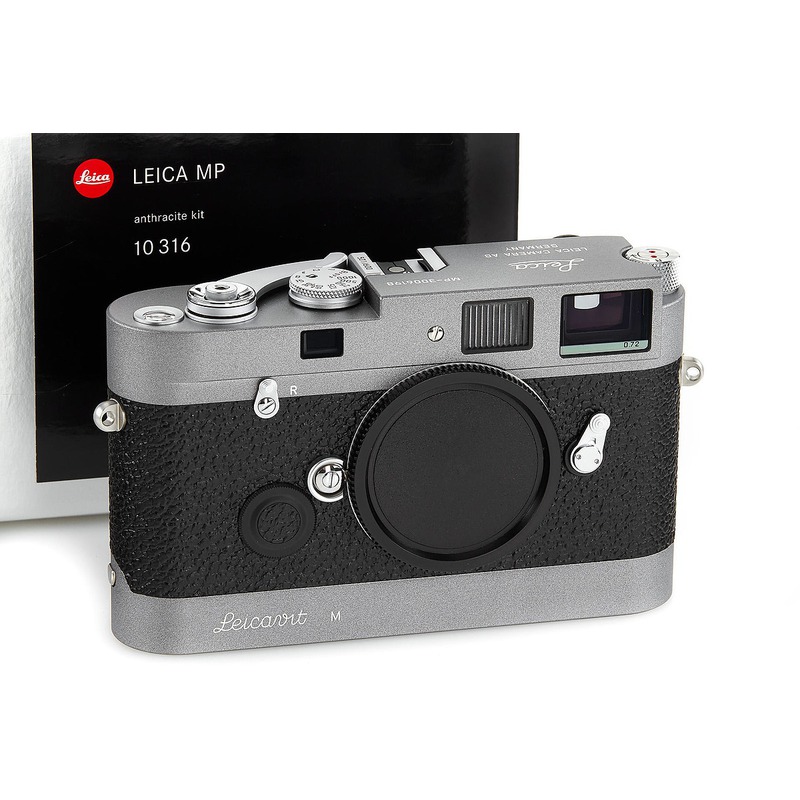
The Leica MP black, released in 2003 with the optional Leicavit rapid-winder attachment, represents a deliberate and significant re-introduction of the classic Leica M rangefinder ethos in an era dominated by digital photography. It is a purely mechanical 35mm (135 format) camera, embodying Leica's commitment to traditional craftsmanship and tactile user experience. The "MP" designation harkens back to the legendary Model M3 of the 1950s, signifying a return to fundamental rangefinder principles without the automation of later models like the M6 or M7. Its design is minimalist and functional, characterized by a robust black enamel finish, top and bottom plates in black-anodized magnesium alloy, and simplified controls compared to its contemporaries. The inclusion of the Leicavit – a thumb-operated lever that advances the film and re-cocks the shutter in a single, fluid motion – was a key feature, offering significant speed increases for shooters accustomed to the manual winding process, harkening back to the pre-M6 era. The camera features a bright, high-contrast viewfinder with brightline frames, coupled with the legendary Leica M mount, providing a direct, unmediated shooting experience highly valued by professionals and purists. The MP was produced in limited quantities, primarily in black enamel, reinforcing its status as a premium, niche instrument rather than a mass-market product. It appealed to discerning photographers seeking a reliable, no-nonsense mechanical tool, particularly photojournalists and reportage photographers who appreciated its quiet operation, reliability, and the tactile satisfaction of pure mechanical function.
Built to Leica's exacting standards, the MP black excels in build quality. Its construction utilizes high-grade materials – brass, stainless steel, magnesium alloy, and durable enamel – ensuring exceptional durability and a reassuring heft. The mechanical components are precision-engineered and finished to a level uncommon in modern production, contributing to its legendary reputation for longevity and reliability. While its technological specifications (a mechanically controlled shutter ranging from 1s to 1/1000s) are intentionally straightforward, the camera's true significance lies not in innovation but in its role as a high-fidelity instrument preserving the analog rangefinder tradition. It bridged the gap between the classic era of mechanical Leicas and the modern collector market, appealing to those who valued process over pixels and sought a camera built to last a lifetime. Its production was intentionally limited, and its black enamel finish became particularly iconic, distinguishing it from the chrome versions of other M models.
Specifications
| Film Format | 135 |
/main.jpg)
/main.jpg)
 Enjoy this museum? Support on Ko-fi