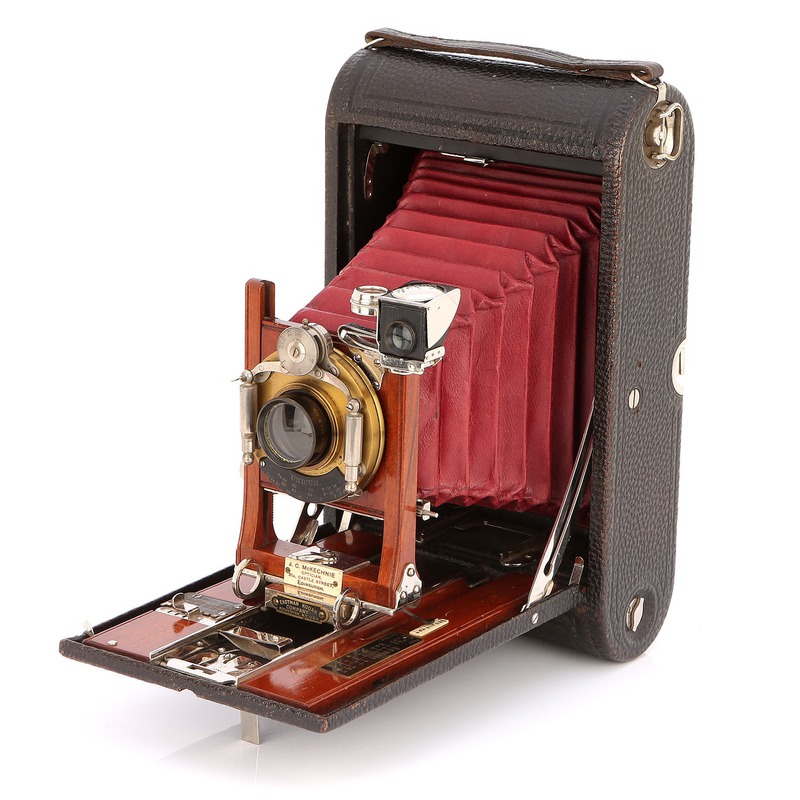
Kodak Folding No.4A
Kodak · USA
The Kodak Folding No.4A represents the company's commitment to making photography accessible to the average consumer during the early-to-mid 20th century. As a folding camera, it featured a collapsible design that made it portable while still offering the larger negative sizes that produced higher quality images than simpler box cameras. This camera likely used roll film in a medium format, typical of the No.4 series, which Kodak produced to cater to enthusiasts who wanted better image quality than entry-level models could provide while still maintaining reasonable portability. The folding mechanism was a practical innovation that allowed the camera to be carried in a smaller case when not in use.
The No.4A exemplifies Kodak's business strategy of offering multiple camera models at different price points and complexities. While not revolutionary in its design, it represented a good balance between portability, image quality, and affordability for its time. These cameras were widely used by amateur photographers and family documentarians who wanted to move beyond simple box cameras but didn't need the complexity or expense of professional equipment. The straightforward controls and reliable operation made them practical everyday tools for capturing memories during an era when photography was becoming increasingly democratized.
/main.jpg)
 Enjoy this museum? Support on Ko-fi