_'Leih-Kamera'/main.jpg)
Pricing
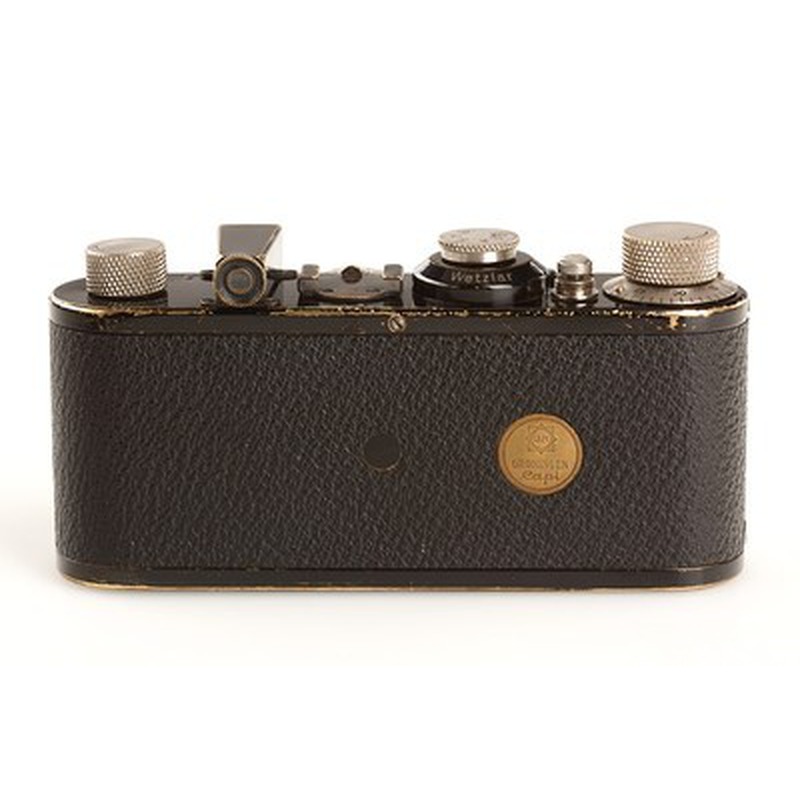
Leica I Mod A (Elmax) 'Leih-Kamera'
Leica · Germany · 1929 · 135 film
Introduced in 1929, the Leica I Mod A (Elmax) 'Leih-Kamera' represents a crucial juncture in Leica's early development and the evolution of miniature photography. While sharing the core 35mm film format and precision engineering that defined Leica's groundbreaking Model I cameras of the 1920s, this specific variant was distinguished by its designation as a 'Leih-Kamera', or loaner camera. This implies it was likely part of Leica's service infrastructure, perhaps used for customer trials, repairs, or demonstrations, highlighting the company's forward-thinking approach to customer support and market education during this nascent era of small-format photography. The 'Elmax' designation likely refers to its early production run utilizing the high-tensile 'ELMAX' steel alloy for the body, contributing to its reputation for robust, miniature construction.
Technically, the Leica I Mod A (Elmax) 'Leih-Kamera' embodies the fundamental Leica principles that revolutionized the industry. It retained the focal-plane shutter with speeds up to 1/500th second, coupled with the brilliant Leica rangefinder for precise focusing, critical for handheld photography. The camera body, typically finished in black enamel over the Elmax alloy, housed a removable back for easy film loading (using standard 135 cassettes) and featured a top-mounted rangefinder/viewfinder combination. While it lacked the advanced features of later Leica models like coupled rangefinder to distance scale or interchangeable lenses on all models (various lens configurations existed), its core achievement was proving the viability and superior image quality of 35mm photography using high-quality optics and a precision miniature mechanical system, paving the way for the entire 35mm revolution. Its existence as a loaner underscores Leica's commitment to promoting this new format.
The historical significance of this specific model is intrinsically linked to the Leica I lineage itself. As an evolution from the original 1925 Leica I and the subsequent Model A, the Mod A refined the concept and solidified the 35mm camera as a serious photographic tool. The 'Leih-Kamera' aspect adds a unique social and commercial layer, illustrating Leica's strategy to overcome skepticism and familiarize professionals and enthusiasts with the radical new system. Famous users of early Leica Is, which this camera directly descends from, included figures like Henri Cartier-Bresson and Alfred Eisenstaedt, who leveraged its portability and discretion to create iconic images that defined photojournalism and street photography. This camera is not just a product; it's a tangible artifact of the moment 35mm photography transitioned from novelty to mainstream dominance, with its loaner status reflecting the practical hurdles and educational efforts that accompanied that transition.
Specifications
| Film Format | 135 |
/main.jpg)
/main.jpg)
/main.jpg)
/main.jpg)
/main.jpg)
 Enjoy this museum? Support on Ko-fi