Pricing
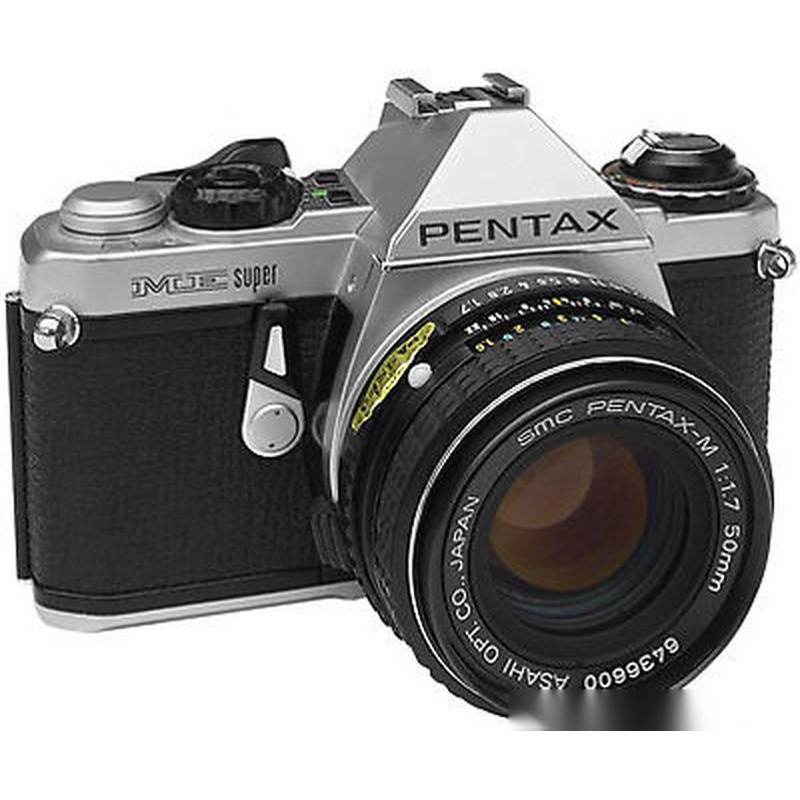
Pentax ME Super
Pentax · Japan · 1979–1984 (5 years) · 135 film
The Pentax ME Super stands as a significant refinement in the evolution of compact 35mm SLRs, building directly upon the success of the original Pentax ME (1976). Released in 1979, it embodied the ongoing trend towards smaller, lighter cameras without sacrificing core functionality or image quality. Its development reflected Pentax's strategy of pushing miniaturization and automation within the robust K-mount system introduced in 1975, responding to a market increasingly valuing portability. The camera represents a pivotal moment where electronic control became standard yet intuitive for amateur and serious enthusiast photographers seeking reliable performance in a manageable package. While not revolutionary in its core design compared to the ME, its key enhancement was the adoption of a superior, more robust metal vertical-travel focal-plane shutter, extending the top speed from 1/1000s to the impressive 1/2000s – a notable technical improvement for its time. This shutter, coupled with the K-mount's compatibility with a vast range of lenses, solidified the ME Super's reputation as a dependable workhorse capable of handling diverse shooting conditions, from bright daylight to slower action. It gained popularity among enthusiasts, journalists, and emerging photographers who appreciated its blend of automation (like match needle metering and aperture-priority AE) and manual override potential, though specific prominent photographers widely documented as *exclusive* users are not readily identifiable without broader historical research.
The ME Super's design story highlights Pentax's commitment to refining established concepts for broader accessibility. It retained the ME's compact dimensions and electronic shutter core but addressed user feedback regarding the original ME's somewhat plasticky feel and shutter limitations by incorporating more metal internal components and the faster shutter mechanism. This resulted in a camera that felt slightly more substantial and offered greater creative flexibility in exposure control. Its build, primarily using a combination of durable plastic and metal for the chassis and lens mount, prioritized lightweight handling without sacrificing the reliability expected from Pentax during the late 1970s and early 1980s. The camera's success lay in its balance: it offered sophisticated electronic automation in a body significantly smaller and lighter than many contemporary SLRs, making it highly practical for daily use and travel, while the K-mount ensured future-proof lens compatibility. It sold well, serving as a primary camera for countless amateur photographers and a reliable second body for professionals, cementing its place as a quintessential example of accessible, well-engineered SLR design.
Specifications
| Type | SLR |
| Film Format | 135 |
| Lens / Mount | Pentax K-F mount |
| Shutter | 4 – 1/2000 s |
/main.jpg)
/main.jpg)
/main.jpg)
 Enjoy this museum? Support on Ko-fi