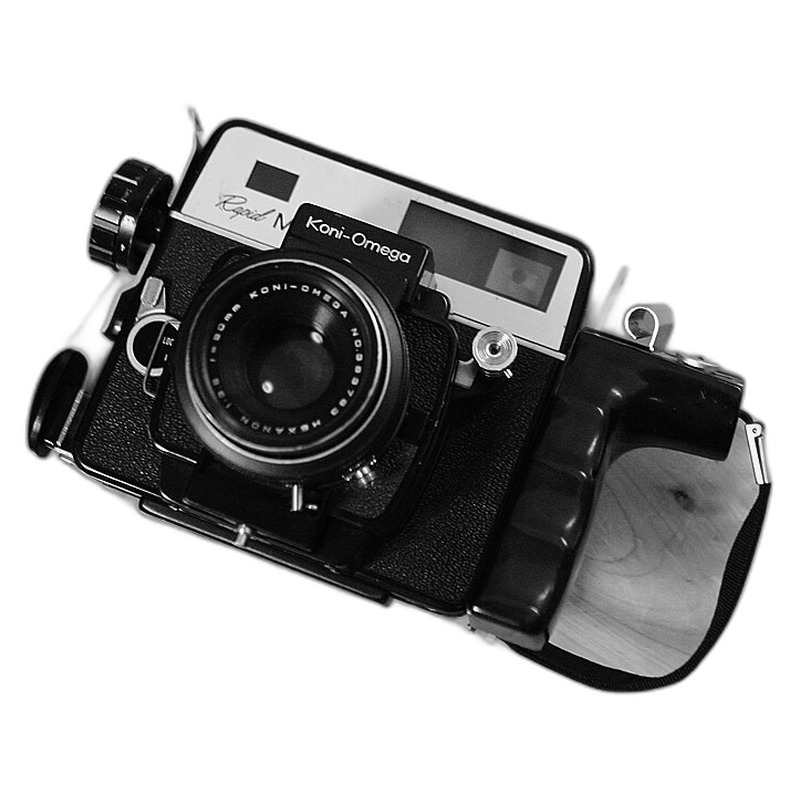
Konica Koni Omega M
Konica · Japan · 1968–1969 (1 years) · 135 film
The Koni Omega M represents a specific moment in Konica's history as the company transitioned its focus from successful medium format roll-film cameras to the burgeoning 35mm market. Produced for only a brief period in 1968-1969, it was essentially a Konica version of the earlier, similarly positioned Koni Omega, adapted for 135 (35mm) film. This camera shared its predecessor's core design philosophy: a compact, relatively simple body featuring a leaf shutter integrated into the lens mount, a fixed or interchangeable lens system (likely including a standard Koninon or Hexanon lens), and a coupled selenium meter for exposure guidance. It catered to photographers seeking a basic, reliable 35mm alternative to the more complex or expensive SLRs gaining popularity, filling a niche within Konica's lineup alongside its more established rangefinder and SLR models. While not revolutionary in design or features, the Koni Omega M serves as a concrete example of Japanese camera manufacturers diversifying their product range during a period of intense competition and format change.
As an early Konica 35mm model, the Koni Omega M is characterized by its straightforward operation and typical Konica build quality of the era. Its leaf shutter offered flash synchronization at all speeds and quieter operation than a typical focal plane shutter. The integrated selenium meter provided basic light measurement without the complexity of through-the-lens metering found in more advanced SLRs. It embodied a functional, practical approach to 35mm photography, appealing to enthusiasts and general users who valued simplicity and reliability over sophisticated automation or interchangeable lens systems. Its limited production run makes it somewhat uncommon today, preserved more as a footnote in Konica's journey towards becoming a significant 35mm SLR player later.
Specifications
| Film Format | 135 |
 Enjoy this museum? Support on Ko-fi