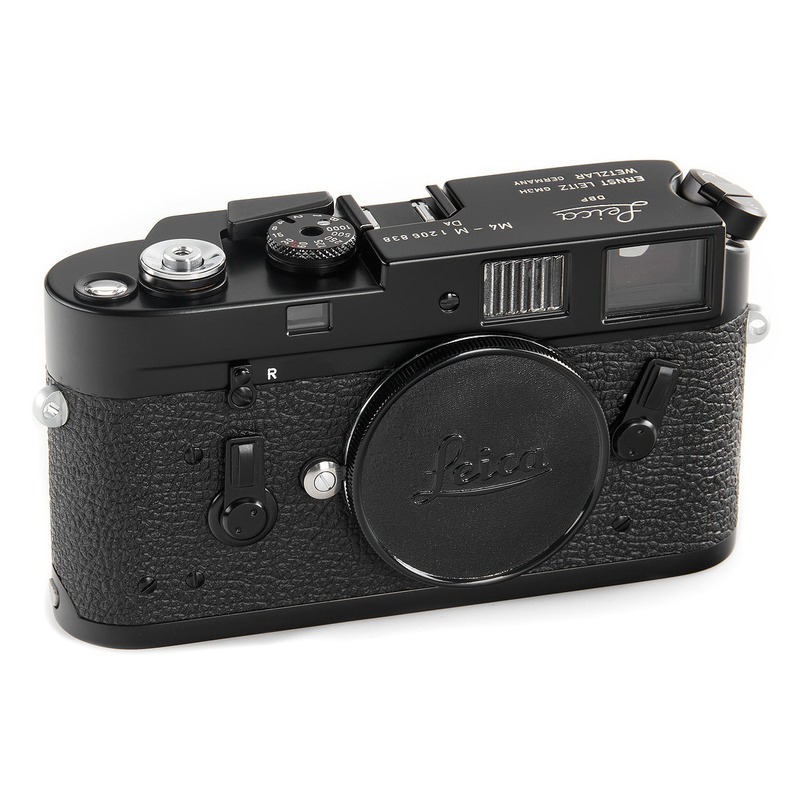
Leica M4-M DA
Leica · Germany · 1969 · 135 film
Introduced in 1969, the Leica M4-M DA represents a subtle yet significant evolution in the venerable M-series rangefinder line. Developed specifically for the American market in response to competitive pressures, this model incorporated practical refinements aimed at modernizing the classic M4 formula. Its key departure from the standard M4 was the inclusion of a self-timer, providing a feature commonly demanded by users. More importantly, it featured enhanced flash synchronization capabilities, offering synchronization speeds up to 1/500th second with electronic flashes via the center contact on the cold shoe, a notable improvement over the M4's slower sync speeds. While retaining the robust, all-magnesium alloy construction and exceptional optics characteristic of Leica, the M4-M DA served as a bridge, incorporating features that would become standard in subsequent models like the M4-2.
Although not a revolutionary redesign, the M4-M DA addressed contemporary user needs and market demands effectively within the established Leica M framework. It was essentially a factory-modified M4, designated as "M4-M" for Military, Police, and Government (later interpreted by some as "Modified") and "DA" for Dealer Assembly, primarily destined for North American distribution. Its production run was relatively short, existing alongside the standard M4 until 1972 before being succeeded by the M4-2. This transitional nature and its specific market focus make it an interesting footnote in Leica's history, demonstrating the company's responsiveness to market feedback while adhering to its core principles of precision engineering and optical excellence.
Specifications
| Film Format | 135 |
/main.jpg)
/main.jpg)
/main.jpg)
 Enjoy this museum? Support on Ko-fi