_(before_war_edition)/main.jpg)
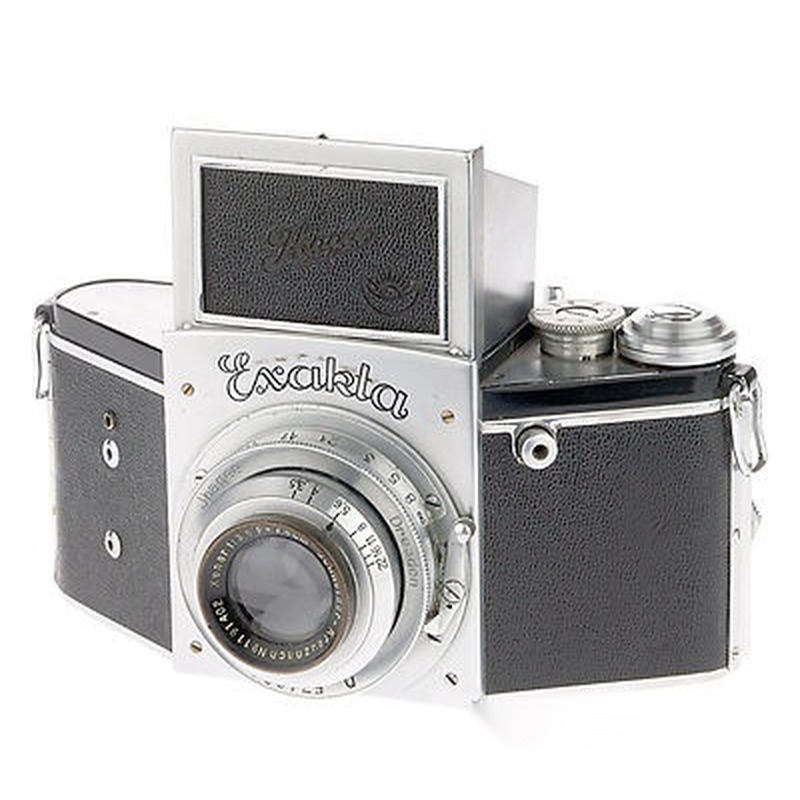
Exakta Kine Exacta I (square viewfinder) (before war edition)
Exakta · Germany
The Kine Exacta I (square viewfinder), manufactured by Ihagee Kamerawerk Dresden before the outbreak of World War II, holds a pivotal place in photographic history as the camera that truly established the 35mm single-lens reflex (SLR) format as a viable and popular system for serious photographers. Building upon the earlier Exakta models (like the Standard and Universal), the Kine Exacta I introduced the iconic square, waist-level finder that became synonymous with the Exakta brand, offering a direct, ground-glass view of the subject through the taking lens. This design, coupled with its groundbreaking use of the 35mm cinema film (loaded in cassettes), provided a compact, versatile alternative to larger plate and roll-film cameras. Its robust, all-metal construction, featuring the characteristic knurled controls and a unique base-plate film loading mechanism, set a standard for durability in the emerging 35mm SLR market.
The camera's significance lies not just in being the first mass-produced 35mm SLR, but in its influence on subsequent camera design and professional photography. It proved the practicality and portability of the SLR concept for field use, inspiring camera makers worldwide, including the Japanese industry that would later dominate the market. While its shutter speeds (up to 1/1000th sec.) and range of interchangeable lenses (including wide-angle, normal, telephoto, and specialized optics) were advanced for its time, the waist-level finder presented a reversed, laterally inverted image – a characteristic of the reflex design that users quickly adapted to. The Kine Exacta I became a workhorse for photojournalists and serious amateurs alike, particularly in Europe before and during the early war years, solidifying Exakta's reputation for innovation in the small-format camera arena.
_(1939)/main.jpg)
_(1948)/main.jpg)
_black/main.jpg)
 Enjoy this museum? Support on Ko-fi