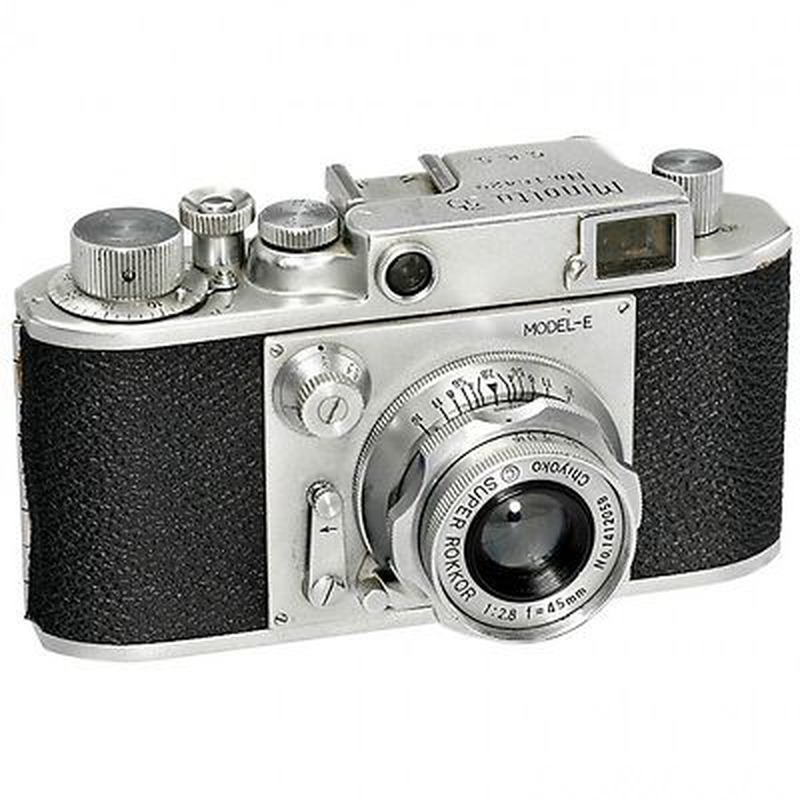
Minolta 35 Model E
Minolta · Japan
The Minolta 35 Model E is a representative example of the post-war Japanese effort to produce affordable 35mm cameras for the emerging mass market. Debuting in the early 1950s, it shares the basic silhouette of contemporary compact rangefinder cameras: a rectangular body, typically finished in black enamel or leatherette, with a coupled rangefinder and a fixed focal-length lens. Its design prioritized simplicity and accessibility, offering a straightforward shooting experience with basic shutter speeds (commonly B, 1/30, 1/60, 1/125, 1/250) and a reasonably fast 45mm or 50mm lens, enabling sharp snapshots in good light. The Model E was Minolta's workhorse for entry-level photographers, contributing significantly to popularizing 35mm photography in Japan and internationally through its reliable, if unadventurous, construction and competitive pricing. It embodies the pragmatic engineering of its era, focusing on functionality and cost-effectiveness over groundbreaking features.
While not possessing the innovations or cultural impact of landmark cameras, the Minolta 35 Model E holds a place as a functional artifact of mid-20th-century photography. Its straightforward controls, coupled rangefinder for accurate focusing at mid-to-long distances, and compact size made it a practical choice for casual users and families seeking to document their lives on affordable roll film. Its production volume ensured its presence in many households, making it a common sight during the 1950s and 1960s. For collectors and historians, it primarily serves as a reference point for understanding the design ethos and manufacturing capabilities of Japanese camera companies during this crucial period of growth and market saturation before more complex SLRs dominated.
/main.jpg)
/main.jpg)
 Enjoy this museum? Support on Ko-fi