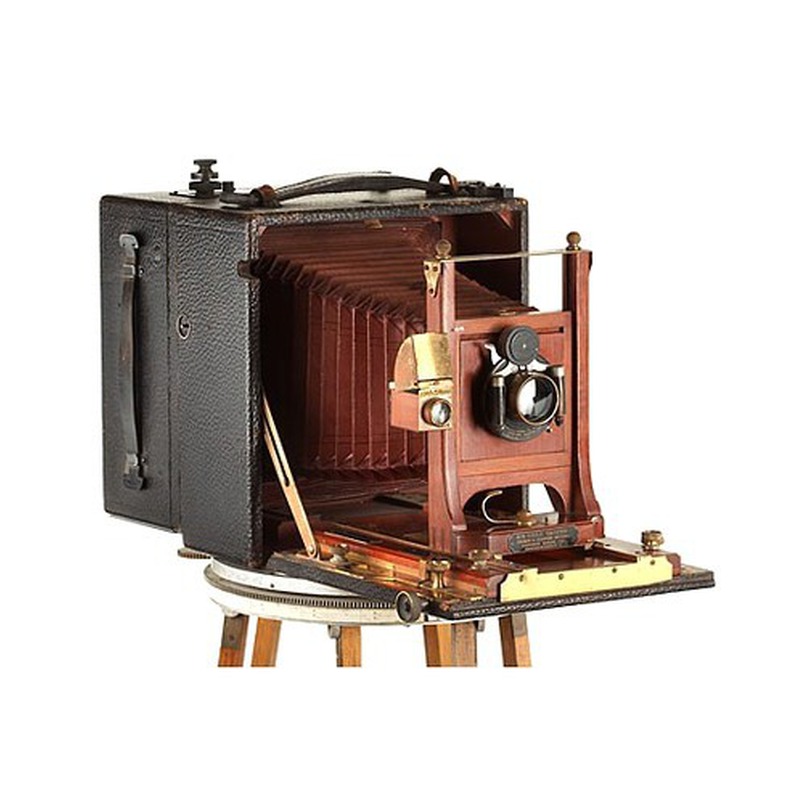
Kodak Cirkut No.8
Kodak · USA
The Kodak Cirkut No.8 represents a specialized professional panoramic camera designed for capturing exceptionally wide, sweeping vistas and large group portraits. As a member of Kodak's renowned Cirkut series, this camera operates on a unique rotating principle: the camera body mounts on a turntable while the film plane remains stationary. During exposure, the camera rotates on its tripod base, typically 180 or 360 degrees, while the film is fed past the lens slit according to the rotation speed. This mechanism enabled the production of panoramic images measuring several feet wide on large-format roll film, making it a tool for ambitious commercial, documentary, and artistic photography requiring an unbroken horizontal perspective. While specific details like exact year or film format are unavailable, the Cirkut No.8 exemplifies Kodak's engineering for the high-end professional market of the early 20th century, focusing on precision and the ability to capture scenes impossible with conventional field cameras. Its purpose was clear: to create immersive, wide-aspect-ratio images that dominated the view for viewers, often used for architectural studies, scenic landscapes, and especially massive group photographs numbering hundreds or thousands of people.
This camera stands out for its mechanical complexity and dedicated function. Constructed for studio or controlled outdoor use due to its size and need for a stable, level tripod mount, the Cirkut No.8 was a significant tool for professional photographers aiming for the grandest possible compositions. It relied heavily on meticulous setup and precise calibration of rotation speed and film feed to ensure sharp, continuous images across the entire sweep. While not a general-purpose instrument like many Kodak consumer cameras, the Cirkut No.8 was a highly capable and specialized instrument that pushed the boundaries of image format, serving photographers who needed panoramic coverage unmatched by other cameras of its era.
/main.jpg)
 Enjoy this museum? Support on Ko-fi