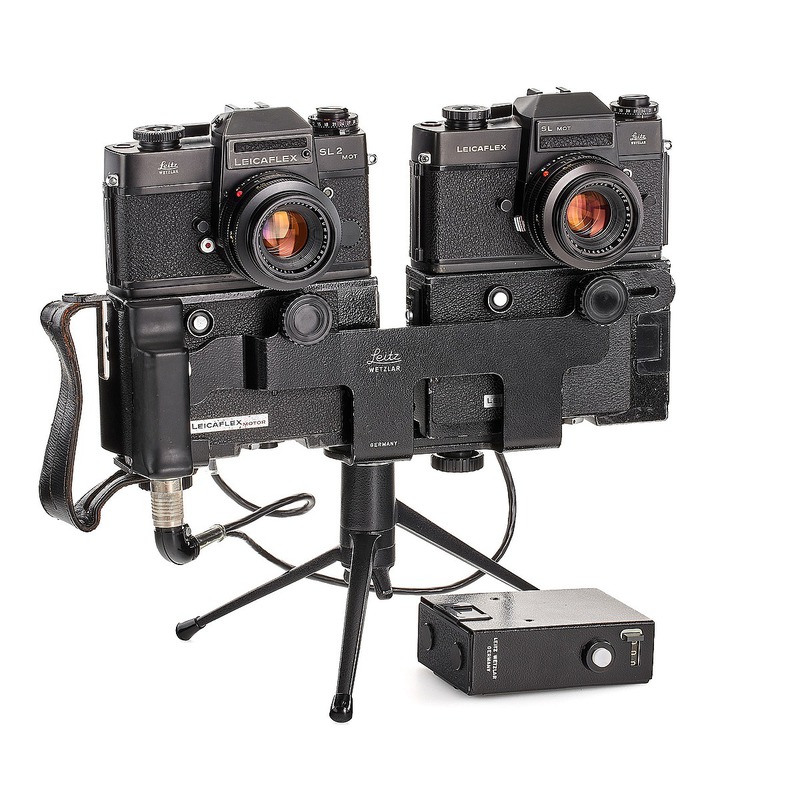
Leicaflex SL2 MOT Tandem
Leica · Germany · 1971 · 135 film
The Leicaflex SL2 MOT Tandem represents the pinnacle of Leica's mechanical single-lens reflex camera design, introduced in 1971 as a specialized variant of the already robust SL2 model. It was the final iteration in the Leicaflex line before the introduction of electronic SLRs, embodying Leica's commitment to precision engineering and rugged reliability for professional photographers. The key distinguishing feature of the "Tandem" designation was its integrated motor drive, enabling rapid film advance at a high frame rate – a crucial capability for fast-paced subjects like sports or photojournalism. This placed it firmly in the professional arena, competing with offerings from Nikon and Canon, and showcased Leica's ability to deliver high-speed performance within their traditionally deliberate mechanical framework. The camera retained the SL2's excellent viewfinder with its projected image frame lines and lever mirror lock-up, maintaining a familiar user experience for Leicaflex users while adding significant shooting speed.
While sharing the core excellence of the base SL2 – including its heavy-duty metal construction, reliable cloth focal plane shutter, and superb bayonet lens mount – the MOT Tandem's primary significance lies in its motorization. This feature was a direct response to the demands of photographers requiring continuous shooting capabilities, making it a practical tool for specialized professional applications rather than a generalist camera. It stands as a testament to Leica's late-1960s engineering prowess and their willingness to incorporate advanced mechanical solutions to meet market needs, marking a significant evolution within their SLR lineage before the shift to electronic automation. Its production run was necessarily limited, contributing to its distinct place in Leica history.
Specifications
| Film Format | 135 |
/main.jpg)
 Enjoy this museum? Support on Ko-fi