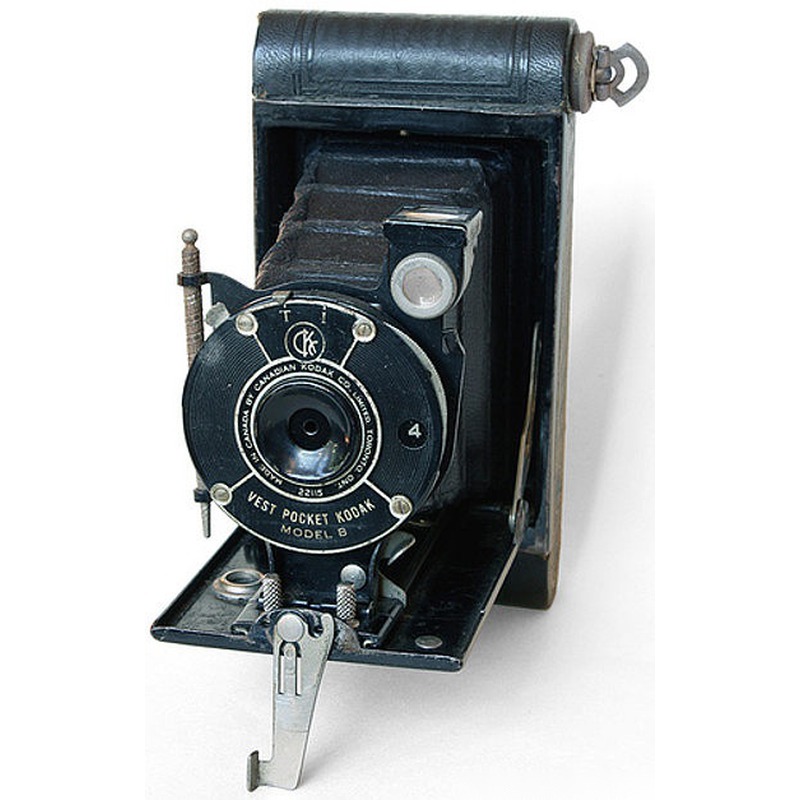
Kodak Vest Pocket Autographic B
Kodak · USA
The Vest Pocket Autographic B represents Kodak's enduring effort to make photography accessible to the amateur market during the early 20th century. As a member of the Vest Pocket series, it embodies the compact, folding camera design that defined Kodak's approach between 1912 and the late 1920s. Its core function was straightforward: to provide a small, portable camera capable of taking 127 format roll film, making photography convenient enough to carry in a vest or coat pocket. The key innovation referenced by its name is the Autographic feature, a unique system that included a small door on the back of the camera. This allowed the user to write on the special carbon paper lining the film's margin with a metal stylus, enabling personal notations or titles directly onto the negative strip itself. While its construction utilized stamped metal panels and relied on simple optics, it effectively democratized image-making for soldiers, travelers, and families during World War I and the subsequent decade.
Despite its lack of groundbreaking technical advancements compared to later landmark models, the Vest Pocket Autographic B holds historical significance as a tool that vastly expanded the reach of photography. Its affordability, portability, and the novelty of the Autographic feature made it incredibly popular, capturing countless everyday moments during a period of immense global change. It was a workhorse camera, designed for practicality and mass production rather than exceptional optical quality or mechanical sophistication. Its legacy lies firmly in its role as a ubiquitous presence in households and battlefields, fostering a culture of amateur snapshot photography long before the advent of miniature 35mm cameras. Its design influenced subsequent pocket folders cemented the "Vest Pocket" concept in photographic history.
/main.jpg)
 Enjoy this museum? Support on Ko-fi