Pricing
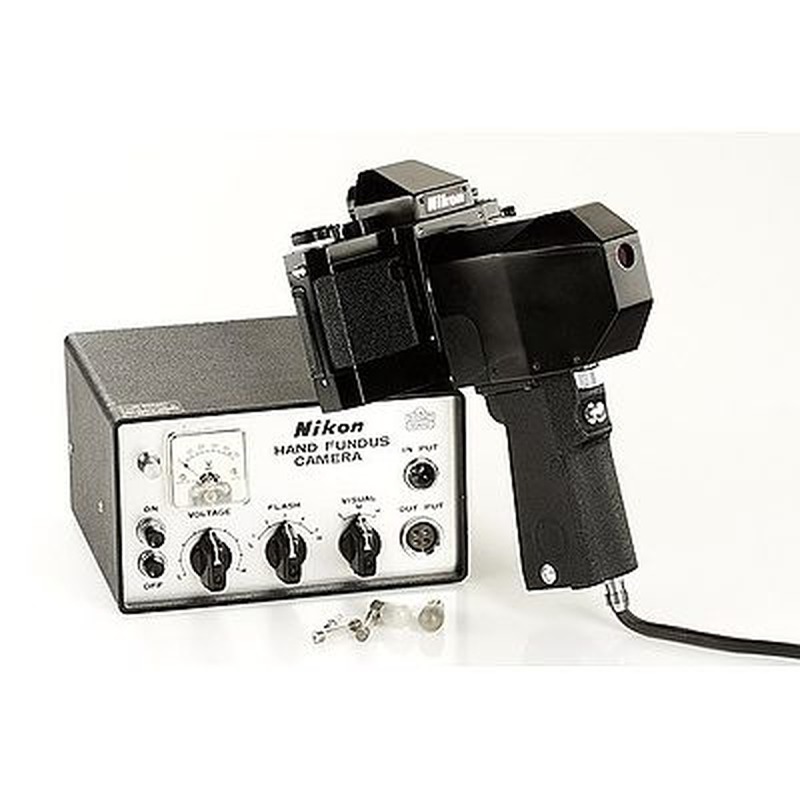
Nikon F Hand Fundus
Nikon · Japan · 1964–1969 (5 years) · 135 film
Produced for specialized medical use from 1964 to 1969, the Nikon F Hand Fundus was a dedicated 35mm camera system designed for ophthalmic photography. It was fundamentally built upon the robust and modular Nikon F SLR chassis, incorporating a specialized attachment comprising a flash unit and a lens assembly specifically engineered to photograph the fundus (the interior surface of the eye) through dilated pupils. This system allowed ophthalmologists to document retinal conditions with unprecedented detail directly onto 35mm film, replacing earlier, often cumbersome, fundus cameras. It leveraged the reliability and precision of the Nikon F system but was tailored solely for this clinical purpose, featuring a flash synchronization system optimized for the intense, brief light bursts required to photograph the retina without pupil constriction. Its significance lies in Nikon's application of its flagship camera technology to a critical medical field, advancing diagnostic capabilities during that era.
While sharing the core durability and excellent mechanical engineering characteristic of the Nikon F line, the Hand Fundus was inherently a specialist instrument, not a general photographic tool. Its design prioritized functionality within the constraints of ophthalmic examination, including specific optical paths and flash requirements. Consequently, its visibility and impact outside the medical community were limited, representing a noteworthy but specialized branch of Nikon's product development rather than a landmark for general photography. Its legacy is tied to the history of medical imaging, showcasing Nikon's engineering prowess in solving specific technical challenges for scientific and clinical applications.
Specifications
| Film Format | 135 |
/main.jpg)
/main.jpg)
/main.jpg)
 Enjoy this museum? Support on Ko-fi