Pricing
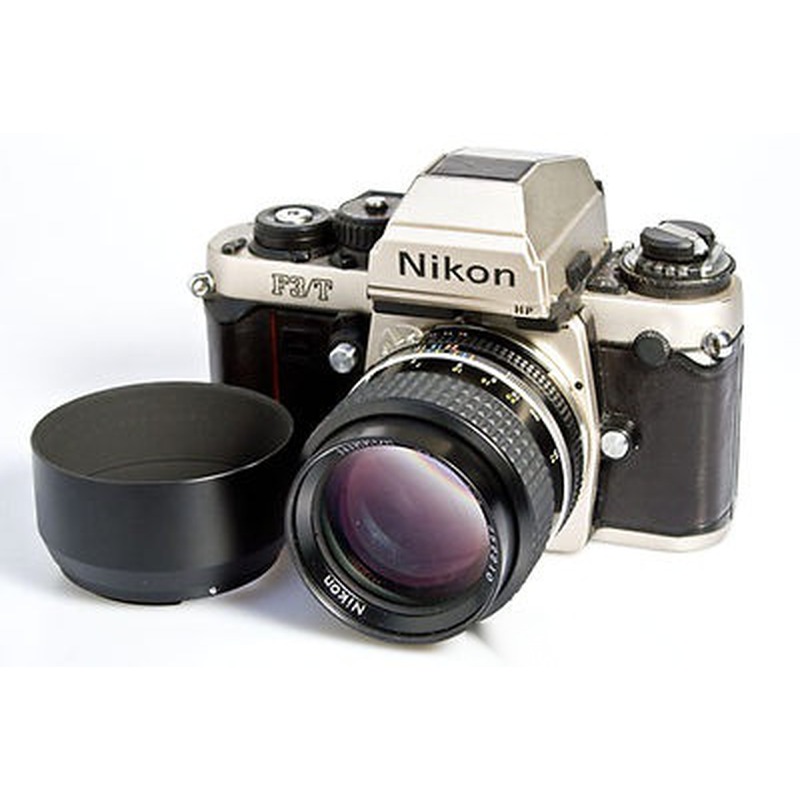
Nikon F3 T
Nikon · Japan
The Nikon F3 T represents a pinnacle achievement in professional 35mm SLR design, building directly upon the legacy of the original Nikon F introduced in 1959. Released in the early 1980s, the F3 T was the titanium-clad version of the Nikon F3, Nikon's flagship professional SLR that succeeded the highly respected F2. The "T" designation signified a body constructed primarily from lightweight and incredibly strong titanium alloy, replacing the standard F3's brass and steel components. This was a significant engineering choice, offering substantial weight reduction while maintaining, and arguably enhancing, the legendary durability and ruggedness expected of Nikon's top-tier cameras. The F3 itself was a landmark, featuring Nikon's first electronically controlled shutter – a move away from the purely mechanical systems of its predecessors – which provided greater reliability and smoother operation. Its advanced TTL metering system was renowned for its accuracy and wide dynamic range, and the camera utilized Nikon's robust F-mount, ensuring lens compatibility back to 1959 and forward for decades.
The F3 T inherited the F3's sophisticated design philosophy: a large, bright viewfinder with interchangeable focusing screens, a highly reliable and quiet vertically traveling metal focal plane shutter rated for a long service life, and intuitive controls ergonomically placed for professional use. It became the workhorse for countless photojournalists, documentary photographers, and serious amateurs during the film era, trusted in the most demanding conditions. Its titanium body made it particularly desirable for photographers who prioritized portability without sacrificing build quality. While the standard F3 was already considered exceptionally well-built, the F3 T elevated the concept using premium materials, embodying the ultimate expression of Nikon's engineering prowess in the mechanical-electronic hybrid phase of SLR development. Its design and functionality set a benchmark for professional cameras throughout the 1980s.
 Enjoy this museum? Support on Ko-fi