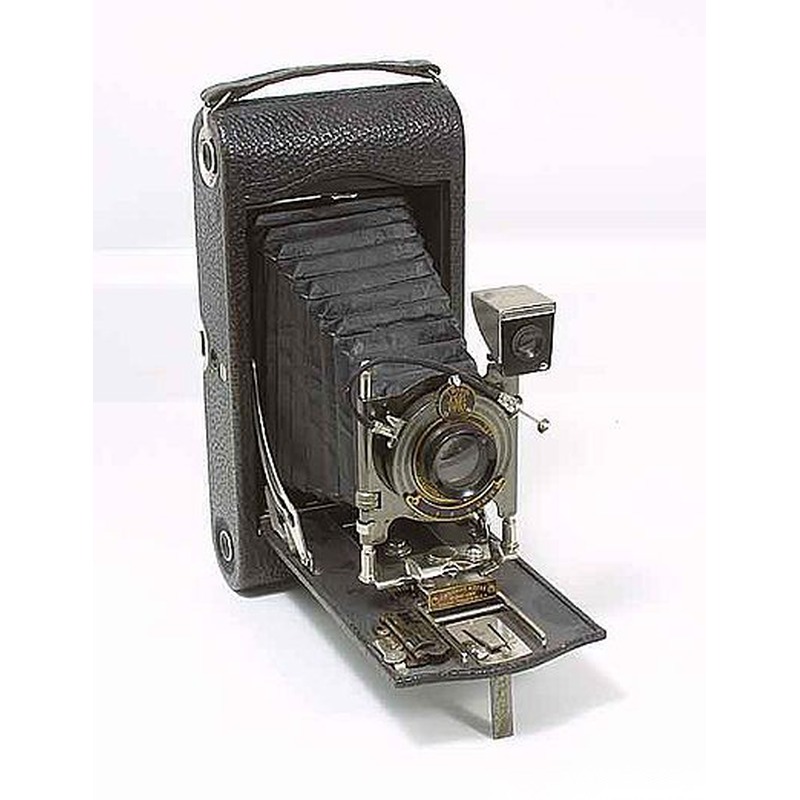
Kodak Folding Pocket No.3A Mod C
Kodak · USA
The Kodak Folding Pocket No.3A Mod C represents a significant step in making photography accessible to the general public during the early 20th century. As part of Kodak's successful line of folding cameras, it utilized the reliable 3A film format, producing larger 3 1/4 x 5 1/2 inch negatives compared to smaller roll-film models, offering improved image quality within a relatively compact package. Its distinctive feature was the bellows design, allowing the lens board to fold into the body for portability, making it a practical choice for snapshots, travel, and everyday use without sacrificing image size. This camera embodies Kodak's core philosophy of simplifying photography, enabling amateurs to take pictures easily by eliminating complex technical adjustments and focusing on the experience of capturing moments. While not introducing groundbreaking technology, it exemplifies the refinement and widespread adoption of roll-film folding cameras that dominated the consumer market for decades, cementing Kodak's dominance in amateur photography.
The camera's construction prioritized functionality over ruggedness, typically featuring a metal body covered in leatherette or simulated leather, with a simple, often brilliant-type viewfinder and a meniscus or rapid rectilinear lens system designed for adequate sharpness at apertures commonly used for snapshot photography. It was aimed squarely at the mass market, emphasizing ease of loading pre-cut film cartridges and point-and-shoot simplicity. Within Kodak's extensive product range, the No.3A Mod C occupied a specific niche as a folding camera offering a larger format than smaller Kodak pocket models like the No.1A or No.2, but was less complex and likely more affordable than larger professional folding cameras. Its historical importance lies not in being a unique innovator, but in being a representative, reliable workhorse that helped millions document their lives, contributing significantly to the social history of photography during its era.
/main.jpg)
 Enjoy this museum? Support on Ko-fi