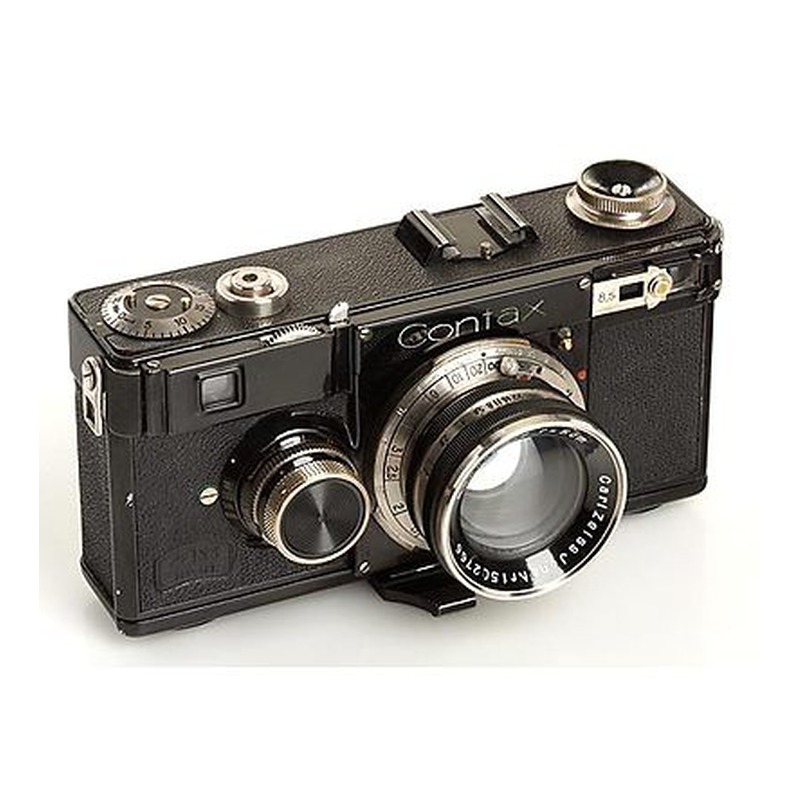
Zeiss Contax I e
Zeiss · Germany
The Contax I, introduced by Zeiss Ikon in 1932, stands as a landmark response to the revolutionary Leica I and II cameras. Developed under the leadership of the brilliant engineer Dr. Hebert Tandich, the Contax I was conceived not merely to imitate Leica, but to surpass it in technical capability and robust construction. It featured a significantly larger and heavier body compared to the Leica, housing a complex but exceptionally precise focal-plane shutter with a wider range of speeds (from 1 second to 1/1000th) and an innovative rapid-winding knob on the top plate, far more ergonomic than Leica's knob-and-lever system. Its rangefinder was coupled to a helical focusing mount offering a longer rangefinder base, promising superior focusing accuracy, especially for wider lenses.
The Contax I's sophisticated engineering extended to its lens mount; it utilized a unique bayonet design specifically created for the high-performance Zeiss Biotar, Tessar, and Sonnar lenses, establishing a reputation for outstanding optical quality. While the Contax I's bulk and complexity made it less popular among street photographers than the Leica, it quickly gained favor among studio professionals, press photographers, and discerning amateurs who valued its precision, reliability, and superior image rendering. Its development marked a pivotal moment in 35mm camera history, driving innovation through intense competition and cementing Zeiss Ikon's status as a major player in the emerging small-format market. Its influence is evident in subsequent camera designs, particularly the later Contax II/III models.
/main.jpg)
/main.jpg)
/main.jpg)
 Enjoy this museum? Support on Ko-fi