Pricing
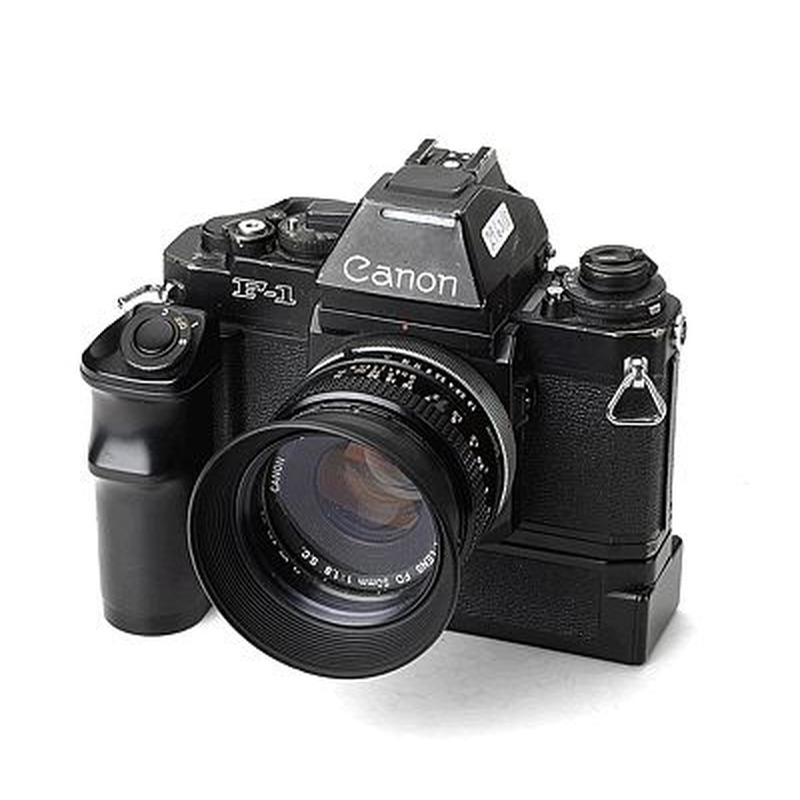
Canon F-1N AE
Canon · Japan · 1981 · 135 film
The Canon F-1N AE introduced in 1981 was a significant refinement of Canon's iconic professional F-1 system, representing the pinnacle of Canon's mechanical and hybrid-mechanical engineering aimed at the demanding professional market. Building directly upon the highly regarded F-1 (released 1971) and the F-1n (1976) update, the F-1N AE incorporated a crucial new feature: aperture-priority automatic exposure (AE), housed within a body largely inherited from its predecessors. This marked Canon's move towards integrating more automation into their flagship SLR while retaining the F-1's legendary ruggedness, modular system compatibility, and precision. The AE mechanism, powered by a single 1.3V SR44 or 357 silver battery, relied on the camera's central meter cell and sophisticated shutter/mirror timing to set shutter speeds automatically when the aperture was chosen. It was not a full electronic control camera like some contemporaries but a sophisticated hybrid addition. The camera retained the F-1's core strengths: a massive, die-cast metal body, reliable cloth focal-plane shutter with speeds from 1s to 1/1000s plus Bulb, excellent pentaprism viewfinder with interchangeable screens and focusing screens, and the ability to accept a vast array of motor drives (like the high-speed Motor Drive A2), finders, and backs. It appealed to professionals and serious enthusiasts who valued the F-1's robustness and now needed AE convenience without sacrificing tactile control.
While sharing the core DNA of the F-1 lineage, the F-1N AE represented a strategic step forward for Canon. It was released alongside a slightly less expensive version without AE (the F-1N), allowing Canon to cater to both traditionalists and those embracing automation within the same premium platform. The addition of AE made the camera significantly more competitive against rivals like the Nikon F2 (which had received its own Photomic TTL finder update) and newer electronic SLRs flooding the market. Its build quality remained exceptional, utilizing premium materials and engineering standards synonymous with the F-1 name. The F-1N AE solidified Canon's position in the professional 35mm arena just before the dawn of fully electronic autofocus systems like the Canon T80 (1985) and the groundbreaking EOS series (1987), making it an important transitional model for the brand's history. It wasn't a groundbreaking design itself but a logical, high-quality evolution of a dominant professional system, maintaining relevance for a critical period in photographic technology.
Specifications
| Film Format | 135 |
/main.jpg)
/main.jpg)
 Enjoy this museum? Support on Ko-fi