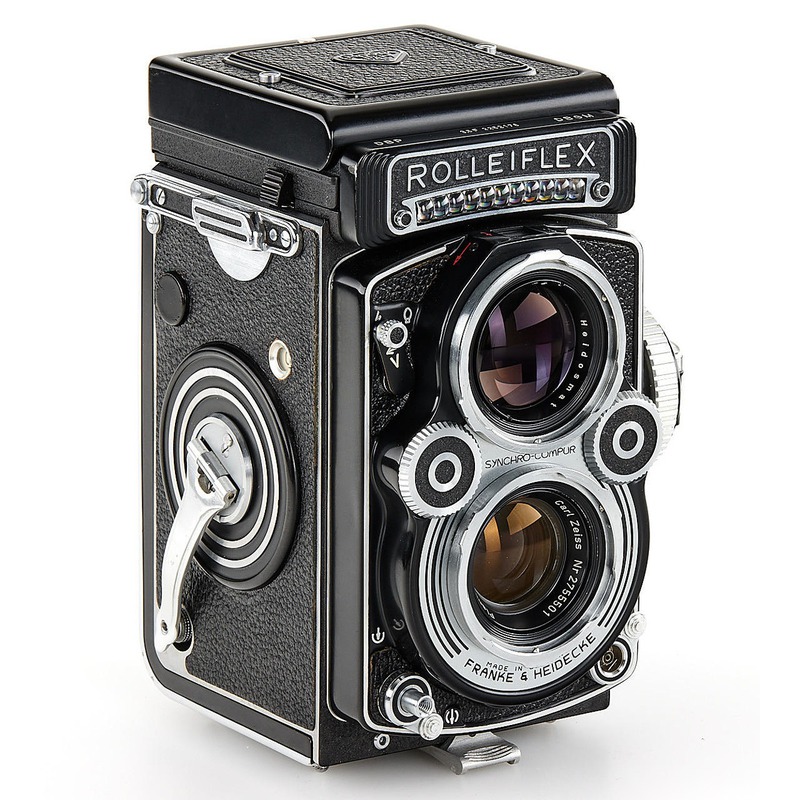
Rolleiflex 3.5 F Model 4
Rollei · Germany
The Rolleiflex 3.5 F Model 4 stands as a refined iteration in Rollei's esteemed twin-lens reflex lineage, exemplifying the German manufacturer's commitment to precision engineering and optical excellence. Produced during Rollei's post-war peak, this model typically features a 75mm f/3.5 lens—either the Zeiss Planar or Schneider Xenotar—renowned for its sharp rendering and contrast, paired with a built-in selenium meter for accurate exposure. Its durable, all-metal construction with advanced focusing mechanisms and the signature waist-level viewfinder provided professionals with a discreet yet reliable medium-format tool, valued for its 6x6 cm negatives that delivered superior detail compared to 35mm alternatives. This camera bridged the gap between Rolleiflex's pre-war innovations and the flagship 2.8F models, becoming a staple for documentary and portrait photographers seeking portability without sacrificing image quality.
While not as groundbreaking as Rolleiflex's original 1929 design, the 3.5 F Model 4 advanced the brand's reputation for robust, user-centric engineering. It maintained the TLR format’s intuitive waist-level composition—favored by street photographers like Robert Capa for its unobtrusive shooting—while offering refinements such as improved flash synchronization and a more compact body. Its production run in the 1950s–60s coincided with Rollei’s dominance in professional and amateur markets, cementing the 3.5 series as a benchmark for medium-format reliability. Though overshadowed by later models, it remains a symbol of Rollei’s golden era, where mechanical perfection met artistic pragmatism.
/main.jpg)
/main.jpg)
 Enjoy this museum? Support on Ko-fi