/main.jpg)
Pricing
Leica M3 black paint (Double Stroke)
Leica · Germany · 1959–1966 (7 years) · 135 film
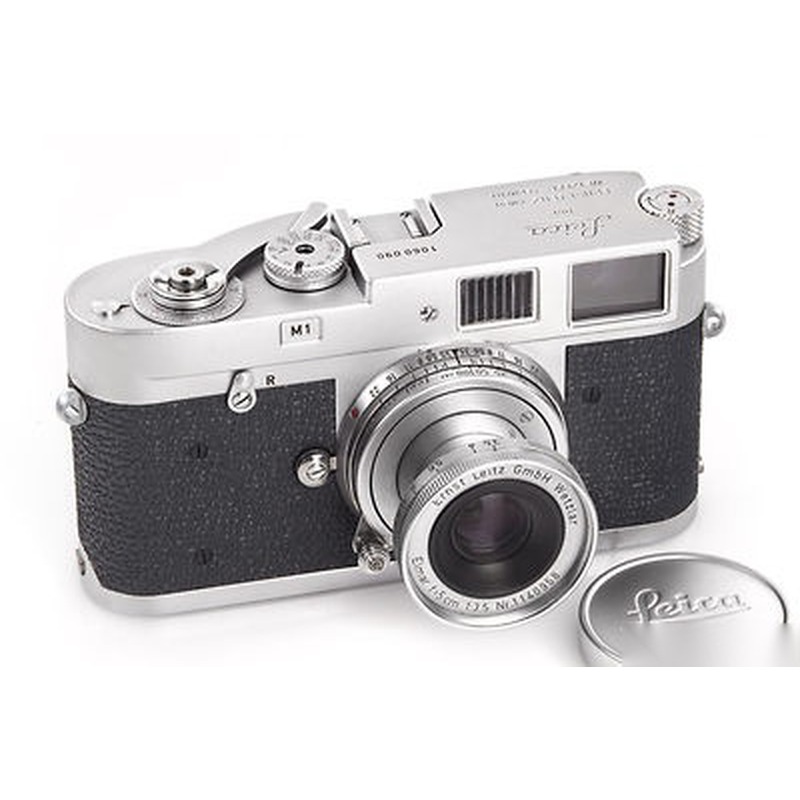
The Leica M3 black paint (Double Stroke), produced from 1959 to 1966, stands as an icon of 20th-century photography and the apex of Leica's rangefinder evolution. Introduced in 1954, the M3 was a revolutionary departure from its predecessors, featuring a groundbreaking combined rangefinder and viewfinder offering a bright, magnified 0.92x view coupled to frames for 50mm, 90mm, and 135mm lenses, a significant leap in focusing accuracy and subject visibility. Its robust, all-black body, crafted from a durable brass alloy with a fine-grain black lacquer finish and meticulous chrome trim, embodied a level of mechanical precision and build quality previously unseen in interchangeable lens cameras. The introduction of the legendary Leica M bayonet mount, allowing rapid lens changes with a simple twist, further solidified its dominance among professionals and serious amateurs. The "Double Stroke" designation refers to the slightly different film advance lever mechanism compared to the initial "Single Stroke" versions, though this is a subtle production detail rather than a major functional change. The M3 became the instrument of choice for countless legendary photographers, most notably Henri Cartier-Bresson, whose decisive moments were captured through its unparalleled viewfinder and quiet, reliable operation.
Beyond its technical innovations, the M3 represented a pinnacle of German engineering and aesthetic restraint. Its controls, though numerous, are logically laid out and operate with a satisfying, deliberate precision – the solid shutter cocking, the smooth film advance, the positive action of the rangefinder coupling. The black paint version, less common than the chrome models, offered a more subtle, elegant appearance. Its production run, spanning over a decade, saw only relatively minor cosmetic and mechanical tweaks, testament to a design perfected upon launch. While superseded by later M models offering brighter finders or simpler operation, the M3's combination of unmatched viewfinder clarity, rock-solid construction, and the classic M bayonet mount ensured its legendary status. It wasn't just a camera; it was a benchmark against which all subsequent rangefinders were, and still are, measured, defining the essence of the Leica M system for generations. Its influence extends far beyond its production years, shaping the design philosophy of countless rangefinder cameras to come.
Specifications
| Film Format | 135 |
/main.jpg)
 Enjoy this museum? Support on Ko-fi